
There is a pattern that repeats across APAC real estate project sales launches so consistently that most teams have stopped noticing it. The inquiry numbers look strong. The broker pipeline is active. The sales team is busy. And then the launch closes and the conversion rate is lower than it should have been, and no one can quite explain where the leads went.
The answer is almost always visibility. Not volume.
The inquiry volume trap
In APAC real estate project sales, lead volume has become the default measure of launch health. A team generating high inquiry numbers feels like a team that is performing, and in a market with strong demand, that feeling is sometimes justified. But volume metrics are a lagging indicator. They tell you what came in. They do not tell you what is progressing, what is stalling, or where in the pipeline the conversion loss is concentrated.
By the time the final numbers show a conversion problem, the launch window has typically narrowed to the point where corrective action is limited. The opportunity to address the real problem, stage-level pipeline leakage, has already passed. We have noticed that property developers who use CRM tools to manage their pipeline see an increase in sales and better forecast accuracy. The gap between high-inquiry and high-conversion teams is almost always an infrastructure gap.
Where APAC real estate project sales pipelines actually leak
The broker coordination gap
In most APAC project sales operations, brokers introduce a significant proportion of buyers; in some markets, the majority. The standard model is that a broker-introduced lead is managed primarily by the broker through to contract completion. This is not a gap. It is the way the channel works.
The gap is coordination and shared visibility. When the broker’s record and the property developer’s CRM are not connected, the developer cannot see where a broker-managed lead is in the process without picking up the phone. If the broker is slow to update, the developer is flying blind. And if communication is not coordinated, the buyer can receive inconsistent messages from both sides simultaneously, which creates friction at exactly the moment the purchase decision is forming.
What unified pipeline management provides is not developer override of the broker relationship, it is a shared view of lead status, stage progression, and next action that keeps the developer informed without requiring the broker to duplicate their work. Both parties work from the same record. Escalations are visible. Nothing falls through the gap between the broker’s system and the developer’s CRM.
Unit availability, dynamic pricing, and launch queue management
Buyers in APAC project markets compare multiple developments simultaneously. The developer who can confirm unit availability, pricing, and payment schedule in real time rather than in 24 to 48 hours via a manual export will consistently win the buyer’s attention.
Three capabilities that high-performing APAC launch teams have in place, and most do not:
- Real-time unit availability. When unit availability data lives in a system updated once a day or on-demand by an admin team, the response time problem is structural. Live inventory that updates the moment a unit is reserved or released is the only viable solution at launch scale.
- Dynamic pricing settings. Effective APAC property launches require the ability to adjust pricing based on real-time absorption signals. Unit types moving faster than expected can be repriced upward to capture margin. Slower-moving configurations can be adjusted before they become a post-launch problem. A CRM with dynamic pricing controls gives the sales director a live instrument panel during the launch, not a fixed price list that cannot respond to demand.
- Queueing and token management. For high-demand property launches in markets like Singapore, Malaysia, and select Australian cities, managing buyer queues through EOI (Expression of Interest) or token systems is standard practice. A CRM that handles queue management, assigning priority, managing unit selection windows, and tracking token status eliminates the manual coordination overhead that creates errors, disputes, and buyer dissatisfaction at the highest-demand moments of a launch.
Follow-up cadence breakdown
Research on high-consideration purchase behaviour consistently shows that response time and follow-up frequency are among the strongest predictors of conversion. Leads receiving a substantive follow-up within hours convert at significantly higher rates than those waiting days. In a fragmented pipeline, follow-up cadence is a manual responsibility depending entirely on individual salespeople remembering who needs to be contacted and when. In a unified pipeline, it is an automated workflow covering prompts, stage progression, and reminders that operates consistently regardless of team workload.
What pipeline visibility means for a launch team
The APAC real estate project sales teams that consistently outperform on conversion are not generating better leads than their competitors. They are managing their existing pipeline with more precision.
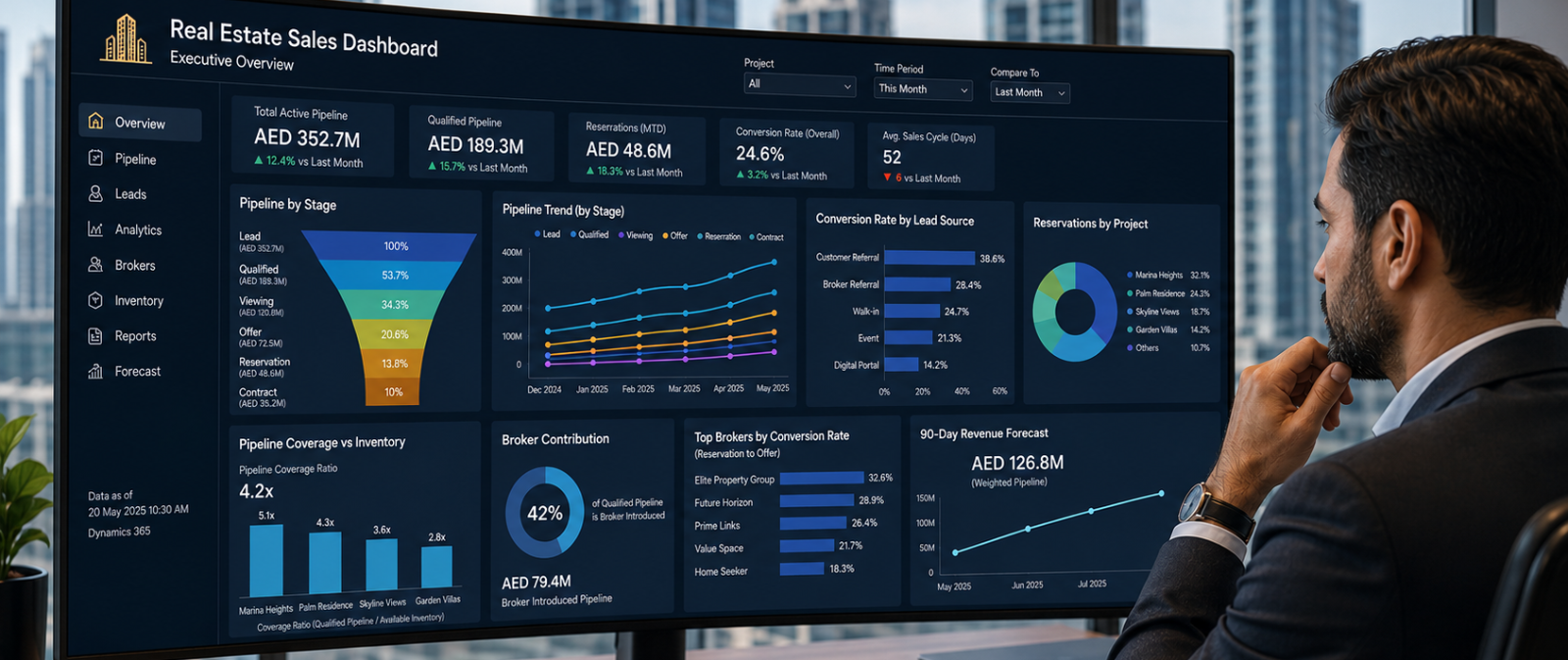
Specifically, they can answer four questions that fragmented teams cannot. Which stage is each lead at? Which broker channel brought it in, and what is that channel’s conversion rate? Which unit types are moving and which are stalling? Which leads are 72-hour opportunities versus longer nurture cycles? These are not sophisticated analytics questions. They are basic pipeline management questions, answerable in real time when the data infrastructure supports it.
The infrastructure question behind the conversion problem
When an APAC project sales team runs a launch, the technology layer underneath determines how much of the potential pipeline gets worked. A unified CRM with real-time inventory data, integrated broker management, dynamic pricing controls, queue management, and automated follow-up workflows converts a higher proportion of the same inquiries than a fragmented setup. Not because the leads are better, but because fewer are lost to operational gaps.
Both Property-xRM and PropertyFlex provide this infrastructure for APAC real estate project sales; bringing together lead capture, broker channel management, unit availability, dynamic pricing, and follow-up workflows in a single system. Property-xRM, built on Microsoft Dynamics 365, is the more mature solution with a longer track record at enterprise scale across GCC and APAC markets. PropertyFlex, built on Salesforce, is well-suited for teams already in the Salesforce ecosystem or those requiring a leaner deployment path.
Teams running launches on either platform see where pipeline is leaking in real time during the launch when there is still time to act, not in the post-launch debrief.
The Real Indicator: – Volume metrics are a lagging indicator in project sales. Teams with unified pipeline visibility see where leads stall in real time, before the launch window closes and before the conversion gap becomes a revenue gap.
Where to start
The diagnostic question is simple: do you know where your inquiries are going? Not just into the pipeline, through it. Which stage is converting and which is leaking? If the answer requires checking three systems or asking three people, the visibility gap is already identified.
The fix does not require rebuilding the team. It requires a single source of truth where broker introductions, lead records, unit availability, dynamic pricing, and follow-up actions all live together in real time. When that infrastructure is in place, the same inquiry volume produces better conversion and the same launch delivers more without requiring more marketing spend at the top of the funnel.
See Metadata in action for APAC project sales.


Frequently Asked Questions
Why do APAC property developers lose leads during project launches despite high inquiry volumes?
The most common reason is pipeline stage invisibility. Teams track inquiry volume but not stage-level progression. When lead data, broker communications, and unit availability live in separate systems, follow-up actions fall through the gaps between them. Leads that should progress to viewing or offer stages stall because no one has a unified view of where they are. Research shows that more sales are closed by teams with CRM-driven pipeline management compared to those tracking volume alone, because the system rather than individual memory drives follow-up consistency.
What is a realistic conversion rate for off-plan project sales in Southeast Asia?
Conversion rates for off-plan project sales in Southeast Asia typically range from 3 to 8%, varying significantly by market, project type, and price point. Luxury and resort developments in markets like Thailand and Indonesia tend to sit at the lower end due to longer buyer decision cycles, while mid-market launches in Singapore and Malaysia can reach 6 to 10% with well-managed pipelines. The difference between a 4% and a 7% conversion rate on a 1,000-inquiry launch is 30 additional sales, making pipeline management the highest-leverage variable within the developer’s control.
How should APAC developers structure their broker channel management in a CRM?
Effective broker channel management in APAC project sales requires three CRM capabilities. First, a real-time inventory access layer that gives brokers accurate unit availability and payment schedule data without manual updates. Second, channel-level conversion tracking that attributes each sale to the originating broker firm and individual. And third, alert-based relationship management that surfaces which broker relationships need attention based on activity levels and conversion trends. Developers with this structure in place can have evidence-based broker channel conversations and shift resources toward the highest-performing channels dynamically across a launch.
What pipeline metrics should an APAC project sales team track beyond inquiry volume?
Beyond inquiry volume, high-performing APAC project sales teams track stage conversion rate (the percentage of leads progressing from inquiry to viewing, offer, and sale at each stage), broker channel conversion rate (which firms and individuals are closing at what rate), unit type absorption rate (which configurations are moving and which are stalling), follow-up response time (how quickly leads receive a first substantive response), and pipeline velocity (the average time from enquiry to offer for converting leads). These metrics, visible in a unified CRM dashboard, allow course-correction during a launch rather than after it.
How does a unified CRM improve property launch performance for APAC developers?
A unified CRM improves APAC project launch performance by eliminating the three main causes of lead loss. Broker handoff gaps are resolved because a unified system gives both broker and developer teams the same lead record. Slow unit availability responses are resolved because live inventory data replaces manual update cycles. And inconsistent follow-up cadence is resolved because automated workflows ensure every lead receives timely follow-up regardless of team workload. The aggregate effect is a higher proportion of the same inquiry volume progressing to offer and sale, without requiring more marketing spend to generate more leads at the top of the funnel.

 Apr 19, 2022