Key Takeaways
- A residential portfolio, a commercial and retail portfolio, and a mixed-use portfolio each place different demands on a CRM.
- Residential portfolios move fast and stay relatively simple to track, but that simplicity has limits.
- Commercial and retail portfolios involve longer, more complex relationships that a fast-moving residential CRM isn’t built to handle.
- A mixed-use portfolio needs to represent residential, commercial, and retail requirements inside the same system at the same time.
- A CRM built for one of these, residential, commercial, retail, or mixed-use, tends to struggle the moment a business operates in another.
- What works for a single-category portfolio rarely scales cleanly once a business adds a second property type to it.
- The right CRM setup depends on which of these a real estate business runs, and how they sit together in one portfolio.
Portfolios rarely stay simple for long. A developer who built residential towers takes on a retail podium. A commercial leasing business adds residential units to its next project. A property management company running offices and shopping centres picks up a block of apartments. Whatever the order, the same pattern shows up soon after: the CRM that worked fine before starts to feel like it’s fighting the business rather than running it. Deal stages don’t match what’s actually happening. Lease dates get flagged at the wrong time. The report that goes to the board stops reflecting what’s really happening on the ground.
This isn’t a case of a bad system. It’s a case of a system built around one kind of property being asked to also run a completely different kind, without anyone redesigning it for that. Residential buildings, office and retail leases, and mixed portfolios don’t just look different day to day. The people involved, the length of the deals, and what the numbers need to show are genuinely different, and no CRM handles all of it well by default.
What a Residential Portfolio Needs from a CRM
Residential is about individuals and families. Someone buys a unit, or a tenant signs a lease, and the deal is largely self-contained. Sales and leasing look and feel similar here: the deal closes fast, often within a month or two of first interest, and the lease itself is usually a standard, one-year agreement shaped by tenant protection rules that don’t leave much room for negotiation.
Maintenance and service requests run alongside all of this too. They need their own tracking, but it’s mostly about volume, keeping up with hundreds or thousands of units, rather than complicated terms. What a residential business needs from its CRM is simple to describe: know who owns or rents each unit, know when renewals are due, and keep deals moving without anyone falling through the cracks.
Commercial and Retail run on a completely different clock
Commercial and retail work on a different rhythm. The tenant here is a company, not a family, and the decision is about numbers, not lifestyle. A single office or retail lease can take six months to a year and a half to close, and it usually involves a broker, a lawyer, a finance team, and someone senior signing off before it’s done. The lease itself often runs for three to ten years and is full of negotiated terms: rent increases over time, renewal options, and costs the landlord passes through to the tenant.
Retail has its own layer on top of that. Many retail leases charge rent as a base amount plus a share of the tenant’s sales once they cross a certain threshold, which means the numbers have to be checked against actual point-of-sale data, not just a fixed schedule. Common area costs get split based on how much space each tenant occupies, not divided evenly. And if a shopping center loses a major anchor store, other tenants’ leases can trigger rent reductions or even let them walk away; that has to be tracked too. None of this has any equivalent on the residential side.
Facilities and vendor management carry real money here as well. Getting common area charges wrong, or missing a vendor renewal, shows up directly in the numbers the owner cares about. And while leasing is the daily focus, sales activity still happens, buying and selling whole buildings or investment stakes, and it needs to be tracked on its own terms rather than squeezed into the leasing pipeline.
When One Portfolio Holds All Three
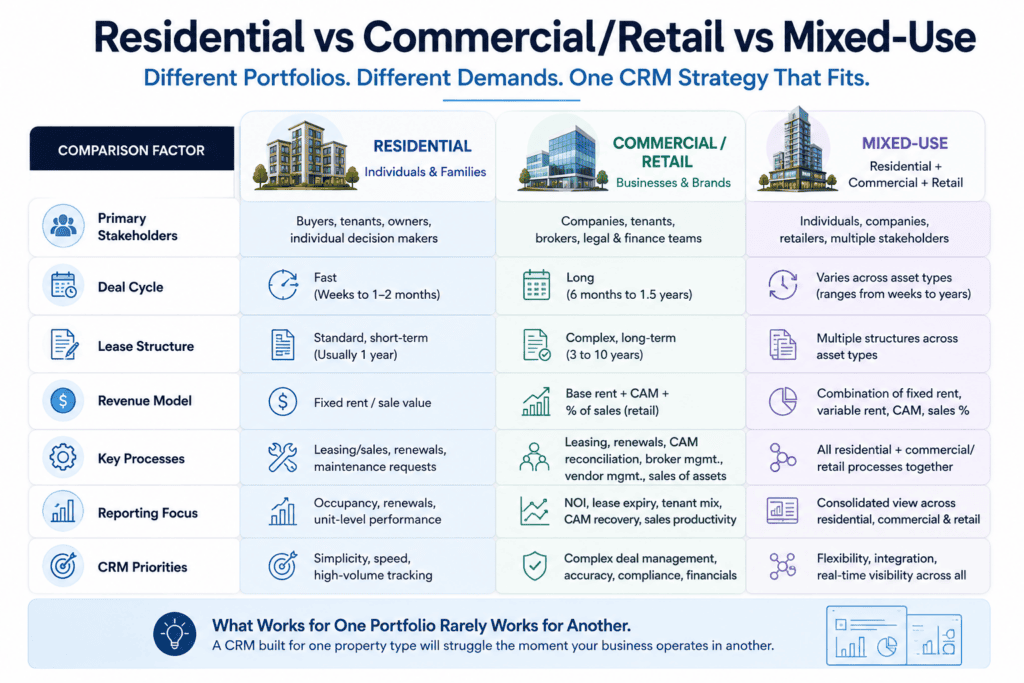
The trouble becomes obvious the moment a business runs both sides at once. One project might have residential units closing every week, office space under a ten-year lease, and a retail wing where rent depends on how much the tenant actually sells, all inside the same portfolio, sometimes the same building.
That’s when a one-size CRM starts breaking down in ways that are hard to ignore. A pipeline built for fast residential deals gets stretched to cover leases that take a year to close, and it doesn’t fit. Sales-linked rent ends up tracked in a spreadsheet because the CRM has nowhere to put it. A renewal reminder tuned for one-year residential leases quietly misses a ten-year commercial deadline, because the system assumes every lease works the same way. None of this is a one-off mistake. It’s what happens, every time, when one data model is asked to do the job of three.
Generic CRM vs a CRM built around the Mixed Portfolio
| What the business needs | Generic or single CRM | A CRM built for the portfolio mix |
| Tracking buyers, tenants, owners, investors | Everyone lumped into one “contact” record | Each relationship type tracked as what it actually is |
| Lease details | Just a start date and an end date | Rent escalations, renewal options, CAM, sales-linked rent, all captured |
| How deals are tracked | One pipeline, one pace, for every deal | Separate pipelines for fast residential deals and long commercial ones |
| Retail-specific terms | Not built in; tracked manually outside the system | Sales-linked rent, anchor tenant clauses, and common area costs handled natively |
| Renewal reminders | Same timing rule applied to every lease | Timed to how each individual lease actually works |
| Reporting to ownership | One dashboard trying to cover everything | Separate views: occupancy and tenant satisfaction for residential, income and lease risk for commercial and retail |
| Handling growth into new property types | Gets harder to manage as the portfolio grows | Extends cleanly as new property types are added |
What Built-for-the-Portfolio Mix Actually Looks Like
Across real estate businesses that run more than one kind of property, the same story tends to repeat. Whichever CRM was chosen for the property type the business started with becomes the sticking point the moment a second type is added, no matter which one came first. It rarely shows up on day one. It shows up months later, when lease renewals start slipping past their deadlines, or when someone quietly goes back to spreadsheets to track sales-linked rent because the system never had a place for it.
Metadata Technologies has been building CRM for real estate, and only real estate, for over two decades, across more than 100 implementations in 12+ countries. Property-xRM, built on Microsoft Dynamics 365, and PropertyFlex, built on Salesforce, come out of that work. Both apply the same real estate logic, shaped to residential, commercial, or retail as a portfolio needs, instead of forcing every property type through one generic pipeline. Whether a business runs on Dynamics 365 or Salesforce comes down to what technology it already uses, not what the system is capable of.
Every portfolio looks different, and the right setup depends on how residential, commercial, and retail sit together in each business. Anyone weighing this for their own portfolio mix is welcome to talk it through directly with Metadata Technologies’ team.
FAQ
What is real estate portfolio management software?
It’s software built to track everything a real estate business owns or manages, leases, tenants, owners, and maintenance, in one place, instead of spread across spreadsheets and separate systems. Generic versions treat every property the same way, which works fine as long as a portfolio stays simple, but starts to strain the moment it isn’t. Metadata Technologies builds two platforms around this exact problem: Property-xRM on Microsoft Dynamics 365 and PropertyFlex on Salesforce, both applying real estate logic to how relationships, leases, and reporting are structured, rather than adapting a generic CRM after the fact.
Is there software built for managing a mixed real estate portfolio?
Yes, though it’s not the default for most CRM or property management platforms. A mixed portfolio, residential units alongside commercial or retail space, needs a system that can hold different kinds of relationships and lease structures at the same time, without forcing one to behave like the other. This is where Property-xRM and PropertyFlex, Metadata Technologies’ platforms for Dynamics 365 and Salesforce respectively, hold separate data models for residential, commercial, and retail properties, so a business doesn’t have to choose between two disconnected systems or stretch one system past its design.
Does lease management work differently across property types?
Yes, and the difference goes well beyond how long a lease runs. Residential leases are short, standardized, and simple to track. Commercial and retail leases run for years, carry negotiated terms like escalations and renewal options, and in retail’s case, rent tied directly to how much a tenant sells. A CRM that only tracks a start date and an end date has no way to represent any of that, which is why Property-xRM and PropertyFlex, built by Metadata Technologies specifically for real estate, capture this level of lease detail natively instead of pushing it out to a spreadsheet.
Can one CRM handle residential, commercial, and retail properties together?
It can, but only if it was designed to from the start. A generic CRM stretched across all three property types usually holds up for a while, then breaks down at the lease and reporting level once a second property type is added to a portfolio built around the first. Metadata Technologies designed Property-xRM and PropertyFlex around this exact requirement, so residential, commercial, and retail can sit in the same system without one distorting how the others are tracked.
Why do generic CRMs struggle with commercial and retail leases?
Because most CRMs are built around a single contact record and a single sales pipeline, a structure that works well for fast, simple deals but not for negotiated, multi-year ones. Commercial and retail leases carry escalations, renewal options, and in retail’s case, rent tied to sales performance, none of which fit neatly into a system designed around a one-year residential lease. Metadata Technologies built Property-xRM and PropertyFlex specifically to close this gap, with lease logic shaped around how commercial and retail deals actually work.
What should a real estate business look for in CRM software for a mixed portfolio?
The key things to check are whether the system tracks lease terms at the level of detail each property type actually needs, whether it keeps separate pipelines for deals that move at very different speeds, and whether it reports on what matters for each: occupancy and tenant satisfaction for residential, income and lease risk for commercial and retail. Property-xRM and PropertyFlex, Metadata Technologies’ CRM platforms for Dynamics 365 and Salesforce, were built around these exact requirements for real estate portfolios, rather than added on top of a general-purpose CRM.

 Apr 19, 2022