
CRM for real estate facilities management replaces the reactive, disconnected maintenance model, WhatsApp groups, email chains, and spreadsheets with a structured, automated operations platform. A CRM-powered FM system covers work order creation and triage, technician scheduling and dispatch, SLA monitoring, planned preventive maintenance, asset lifecycle tracking, and vendor management, all integrated with tenancy records, owner association data, and ERP systems.
Key Takeaways
- Most real estate FM operations are reactive by default. Requests arrive informally, get assigned manually, and close with no audit trail, no SLA record, and no pattern analysis.
- A CRM-powered FM platform covers six core capabilities: work order management, technician dispatch, SLA monitoring, planned preventive maintenance, asset tracking, and contractor management.
- No general CRM vendor such as Zoho, HubSpot, Salesforce can deliver real estate FM depth. This is a purpose-built capability that sits outside the scope of horizontal CRM products.
The FM problem most property operators already recognise
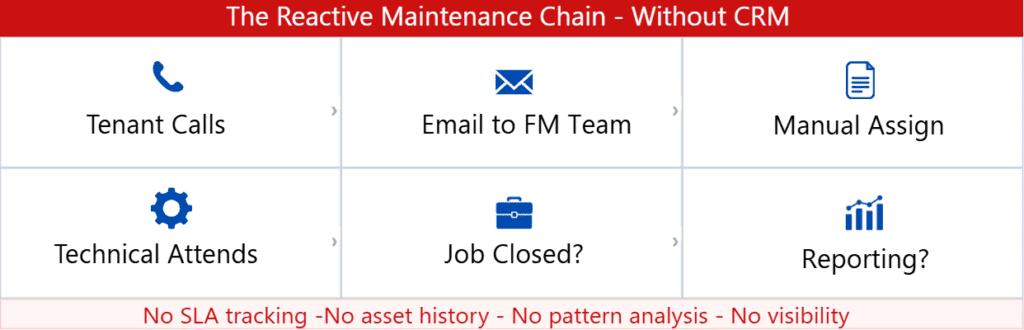
Ask any FM Director managing a large mixed-use portfolio how maintenance requests are tracked, and the answer follows a familiar pattern. Tenants call or message. Someone logs the request on paper, in a spreadsheet, or in a WhatsApp group. The FM team is notified by email or word of mouth. A technician is assigned manually, based on availability and proximity that exists only in someone’s head. The job is done eventually and closed with a message or an email that nobody can find six months later.
At a portfolio of 50 units, this model is uncomfortable. At 500 units, it starts generating complaints and missed SLAs. At 5,000 units with 300+ technicians, dozens of vendor contracts, and a mix of residential, retail, and commercial assets, it becomes an operational liability. Costs compound, service quality degrades, and the FM team spends more time managing the process of managing maintenance than they do actually maintaining the asset.
This article explains what a CRM-powered FM platform changes, covering the six capabilities it introduces, the role of Microsoft Dynamics 365 Field Service as the FM engine, and the operational results that structured FM delivers at scale.
The FM challenge at enterprise scale
The reactive maintenance chain below is the default operating model for most property management organisations. It is not a reflection of the team’s capability; it reflects what happens when FM operations grow without infrastructure.
The direct costs of this model are visible: technician hours wasted on trips without the right parts, jobs reopened because the root cause was not addressed, SLA penalties paid to commercial tenants whose contracts were not met. But the indirect costs are larger. Every tenant whose maintenance request sat unresolved for three days becomes a harder renewal conversation. Every asset failure that could have been prevented by a scheduled inspection becomes an emergency repair that costs three times as much.
The FM function in a real estate enterprise is also a significant source of operational data, asset condition data, maintenance frequency data, contractor performance data, cost-per-unit data that most operators cannot access because it lives in disconnected systems and the memories of individual technicians. A CRM-powered FM platform converts that data into structured, reportable, actionable intelligence.
What a CRM-powered FM Platform covers: Seven core capabilities
The following six capabilities define the difference between reactive FM operations and a structured, CRM-driven maintenance model. Each is described in operational terms the way an FM Director or Property Manager would recognise it in practice
1. Work Order Creation and Triage
Every maintenance request, whether raised by a tenant, a call centre agent, a technician on inspection, or an automated IoT alert is captured as a structured work order with a category, a priority level, an asset reference, and a linked tenancy record. Triage rules automatically assign priority based on asset type, SLA tier, and request category. No request falls through the gap. Everyone is tracked from creation to closure with a full audit trail.
2. Technician Scheduling and Dispatch
The scheduling assistant in Dynamics 365 Field Service matches each work order to the right technician based on skill set, location, current schedule, and parts availability. Technicians receive work orders on their mobile app, update job status in real time, and close jobs with a digital signature or completion confirmation. Dispatchers have a live view of every active job, every technician’s location, and every pending work order, without a phone call.
3. SLA Monitoring and Escalation
Service level agreements in real estate FM are not uniform. A retail tenant in a commercial building has a different SLA than a residential tenant in a tower block. An HVAC failure in a server room has a different priority than a broken fitting in a common area. A CRM-powered FM platform applies the correct SLA to each work order automatically, monitors time-to-response and time-to-resolution in real time and escalates automatically when a threshold is breached to the technician, the supervisor, or the FM Director depending on the escalation rule.
4. Planned Preventive Maintenance (PPM)
Reactive maintenance is always more expensive than planned maintenance, in parts, in technician time, in tenant disruption, and in asset replacement cycles. A CRM-powered FM platform automates the PPM schedule: maintenance plans are defined by asset type and building standard, work orders are generated automatically at the scheduled interval, and the system tracks completion and reschedules missed interventions. Over time, the data from PPM completion enables pattern analysis, identifying assets with above-average failure rates before they become recurring problems.
5. Asset Tracking and Lifecycle Management
A real estate portfolio’s asset register HVAC unit, elevators, generators, fire suppression systems, plumbing infrastructure represents significant capital value and significant maintenance liability. A CRM-powered FM platform maintains a structured asset register linked to the project, property, and unit hierarchy, with a full maintenance history for each asset. This history enables lifecycle analysis: when an asset’s maintenance costs exceed a defined threshold, the system surfaces a replacement recommendation rather than another repair.
Spare parts inventory is a critical dimension of asset management that is frequently underplanned. A CRM-powered FM platform tracks spare parts stock across every warehouse and storeroom in the portfolio and alerts the warehouse manager or technician when a specific part falls below a defined minimum threshold. At that point, the system enables two resolution paths: raise an inter-warehouse stock transfer request to pull the part from another location where it is available, or raise a procurement request that flows directly into the finance or ERP system for approval and purchase order creation. For portfolios running a planned preventive maintenance programme, the platform can cross-reference the upcoming PPM schedule against current spare parts inventory and flag shortfalls before the maintenance date, eliminating one of the most avoidable causes of maintenance delay at scale.
6. Contractor and Vendor Management
Most large real estate FM operations rely on a mix of in-house technicians and outsourced contractors for specialist maintenance. Managing contractor performance without a structured system means SLA compliance is tracked through emails and disputes are resolved without data. A CRM-powered FM platform manages vendor agreements including agreed response times, cost caps, and service scope and tracks contractor performance against those agreements on every job. Underperforming contractors are visible in the data before they become recurring problems.
Dynamics 365 Field Service as the enterprise FM engine
For real estate operators who are evaluating CAFM software or FM management tools, understanding what D365 Field Service delivers natively is important because it is the infrastructure that separates enterprise-grade FM from SMB work order tools.
| Microsoft Dynamics 365 Field Service — Core FM Capabilities | |||
| Mobile technician app Technicians receive, update, and close work orders from the field in real time | Scheduling assistant AI-powered resource optimisation assigns the right technician to the right job | Connected field service IoT sensor integration triggers work orders automatically on asset fault detection | Resource optimisation Minimises travel time, balances workload, and maximises daily job completions |
The mobile technician app is the operational face of D365 Field Service for most FM teams. Technicians receive work orders, access asset history, record parts used, update job status, and close orders from a mobile device with or without connectivity. The scheduling assistant uses AI-driven optimisation to minimise travel time and balance workload across the technician pool. For large portfolios with 100+ technicians across multiple sites, this scheduling capability alone generates measurable efficiency gains.
For a detailed breakdown of all Dynamics 365 modules relevant to real estate CRM — including Field Service, see: Microsoft Dynamics 365 for Real Estate: What Each Module Actually Does and Why the Layer Above It Matters.
One further capability of the Microsoft ecosystem that FM operators should be aware of is the ability to extend the platform directly to tenants and residents. Using Microsoft Power Apps or Power Pages, part of the Microsoft Power Platform and connected directly to the Dataverse that underlies Dynamics 365, a self-service tenant portal or mobile application can be built without custom development. Tenants can log a maintenance request, check the status of an open case, report a new defect, or view their service history directly from a browser or mobile device. That request arrives in the CRM as a structured work order, assigned and tracked through the same FM workflows that manage internally-raised cases with no manual intake step. For FM operations managing a high volume of residential or commercial tenants, this self-service capability reduces inbound call volume, accelerates first-response time, and gives tenants the transparency they expect without adding headcount to the helpdesk.
Metadata’s Expertise- What Property-xRM FM adds on top of Dynamics 365 Field Service
Dynamics 365 Field Service is a powerful FM engine but it is a horizontal platform. It has no concept of a tenancy contract, an owner association levy, a residential unit hierarchy, or a handover defect list. It does not know the difference between a commercial SLA and a residential one. It cannot link an FM cost to a work order in any ERP.
Property-xRM’s FM module provides the real estate-specific layer that makes D365 Field Service operationally relevant for property management organisations. The table below shows what each layer contributes.
| FM Requirement | D365 Field Service alone | Property-xRM FM adds |
| Tenancy-linked cases | Generic customer account record | Work order linked to tenancy contract, unit, and lease status |
| Multi-site asset hierarchy | Flat asset list | Project → Property → Unit → Asset hierarchy with full lifecycle history |
| Outsourced maintenance | Basic vendor record | Vendor agreements, sub-contractor profiles, estimated duration, cost tracking |
| OA and community cases | No owner association concept | Owner association member record linked to FM cases and levy status |
| Handover defect tracking | No link to sales/handover | Defects raised at inspection linked to unit record and assigned for rectification |
| SLA by tenancy type | Single SLA model | Residential, commercial, and retail SLAs configured separately with separate escalation paths |
| ERP cost integration | No financial output | Completed work orders generate cost records in D365 Finance / Oracle EBS / SAP |
FM at scale: What structured operations deliver in practice, a GCC example.
A leading facilities management operator in the Middle East, managing a large mixed-use portfolio across residential, commercial, and retail assets was running FM operations reactively. Work orders were managed through a combination of phone calls, WhatsApp, and manual assignment. There was no SLA tracking, no preventive maintenance schedule, and no visibility of technician performance across the portfolio.
After implementing Dynamics 365 Field Service and Property-xRM’s FM module, the organisation centralised all work order management, automated SLA monitoring and escalation, deployed the mobile technician app across 300+ field staff, and established a planned preventive maintenance programme across the full asset register.
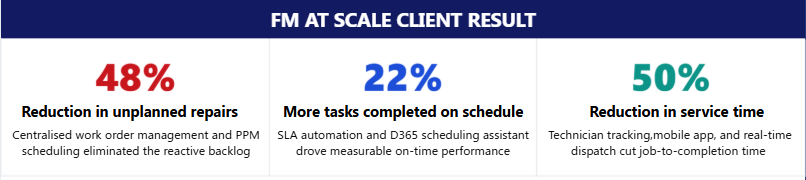
The before-and-after picture was not a technology change. It was an operational model change from a reactive FM function that managed problems as they arrived, to a structured FM operation that prevented problems before they were raised, resolved them faster when they occurred, and produced the reporting data that management needed to make investment and resourcing decisions.
Five FM readiness questions to ask before your next budget cycle
The transition from reactive FM operations to a CRM-powered FM platform is not a technology decision, it is an operational one. The right time to make it is before the next SLA dispute with a commercial tenant, before the next asset failure that a PPM schedule would have caught, and before the next FM Director spends another Friday afternoon compiling a portfolio report from spreadsheet exports.
If you answer yes to three or more of the questions below, your FM operations are ready for a structured platform conversation.
| Question | What a ‘yes’ signals | |
| Question 1 | Are your maintenance requests currently managed through WhatsApp groups, email chains, or a shared spreadsheet? | Your team is operating without visibility, triage, or SLA tracking. Every request is a manual process. |
| Question 2 | When a tenant calls about an ongoing maintenance issue, can anyone on your team see the full history of that request in under 30 seconds? | If the answer is no, your asset and service history lives in individual inboxes rather than a shared system. |
| Question 3 | Do you have a formal planned preventive maintenance schedule, or do you find out about asset failures when tenants complain? | Reactive-only operations are the most expensive model. PPM schedules prevent failures before they generate complaints and costs. |
| Question 4 | Can you produce a real-time report showing SLA compliance rate, average resolution time, and outstanding work orders across your full portfolio right now? | If this requires an export and manual compilation, your FM operations are producing data but not insight. |
| Question 5 | When a unit is handed over to a new owner, does the FM team automatically receive the defect list and scheduled inspections from the sales and handover team? | If this handover is manual or informal, your FM team is starting every new tenancy with a data gap. |
If you answered YES to three or more
Your FM operations are producing cost, risk, and dissatisfaction that a structured CRM platform would eliminate. Property-xRM FM has been deployed across leading real estate enterprises in the GCC to solve these problems. Schedule a Discovery Call to see what a structured FM model looks like for your portfolio
Conclusion: FM is where the tenant experience is made or lost
The sales team closes the deal. The FM team keeps the promise.
Every maintenance request that is resolved on time reinforces a tenant’s decision to renew. Every reactive failure that could have been prevented, an HVAC breakdown in summer, a leak that was flagged in an inspection and never addressed erodes it. At portfolio scale, FM operations are not an operational cost centre; they are a revenue retention function.
The CRM-powered FM model described in this article built on Microsoft Dynamics 365 Field Service and extended by Property-xRM’s real estate-specific layer transforms FM from a reactive cost function into a structured, measurable, and continuously improving operational capability.
The operators who have already made this transition are managing more assets with the same teams, resolving issues faster, preventing failures earlier, and producing performance data that gives leadership confidence in the FM function.
Related reading: The Real Estate Operations Platform: Why Leading Developers Are Moving Beyond Basic CRM for a broader view of how FM fits into the unified real estate operations platform.
Talk to the team that has automated FM operations for leading real estate enterprises across the GCC
FAQ on CRM for real estate facilities management
What is CAFM software and how does it work in real estate?
CAFM (Computer-Aided Facilities Management) software is a platform that manages the full lifecycle of maintenance operations in a real estate portfolio, from work order creation and technician dispatch to SLA monitoring, planned preventive maintenance, and asset lifecycle tracking. In real estate, CAFM software should integrate with tenancy records, owner association data, and ERP systems. Property-xRM on Microsoft Dynamics 365 Field Service is an enterprise-grade CAFM solution purpose-built for real estate FM operations.
What is the difference between CAFM and CMMS in real estate?
CMMS (Computerised Maintenance Management System) focuses on managing maintenance work orders, assets, and technician scheduling. CAFM is broader, it extends maintenance management to include space management, contract management, SLA compliance, and integration with tenancy and ownership records. For real estate enterprises managing mixed-use portfolios, a CAFM-capable platform integrated with a CRM is more appropriate than a standalone CMMS, as it connects FM operations to the full customer and tenancy data layer.
What is reactive vs preventive maintenance in property management?
Reactive maintenance is responding to failures after they occur, a tenant reports a fault, a work order is raised, a technician is dispatched. Preventive maintenance (PPM) schedules maintenance interventions before failures occur, based on asset type, manufacturer guidelines, and historical performance data. Reactive-only FM operations are significantly more expensive: emergency repairs cost more in parts, technician time, and tenant disruption than scheduled maintenance. A CRM-powered FM platform automates PPM scheduling and tracks completion against the maintenance plan.
How does Dynamics 365 Field Service work for real estate FM?
Dynamics 365 Field Service provides the enterprise FM backbone for real estate operations: work order management, a mobile app for technicians, an AI-powered scheduling assistant, IoT-triggered work orders, and real-time job tracking. Property-xRM extends D365 Field Service with real estate-specific capabilities, tenancy-linked cases, multi-site asset hierarchies, SLA rules by tenancy type, outsourced contractor management, and ERP cost integration making it a purpose-built FM platform for developers and property management organisations.
What is SLA management in real estate facilities management?
SLA (Service Level Agreement) management in real estate FM means defining, monitoring, and enforcing the response and resolution time commitments made to tenants, owners, and community members for maintenance requests. In a mixed-use portfolio, SLAs typically differ by asset type, request category, and tenancy type, a commercial tenant’s HVAC failure has a different SLA than a residential tenant’s plumbing issue. A CRM-powered FM platform applies the correct SLA to each work order automatically and escalates to the appropriate manager when thresholds are breached.
How do property managers track maintenance performance across a large portfolio?
Property managers track FM performance by measuring key operational metrics: SLA compliance rate (percentage of work orders resolved within the agreed timeframe), first-time fix rate (percentage of jobs closed without a return visit), average resolution time by asset category, PPM completion rate, and cost-per-unit. These metrics are only accessible in real time if FM operations run on a structured CRM platform. On a reactive, spreadsheet-based model, performance tracking is retrospective, manual, and incomplete.

 Apr 19, 2022