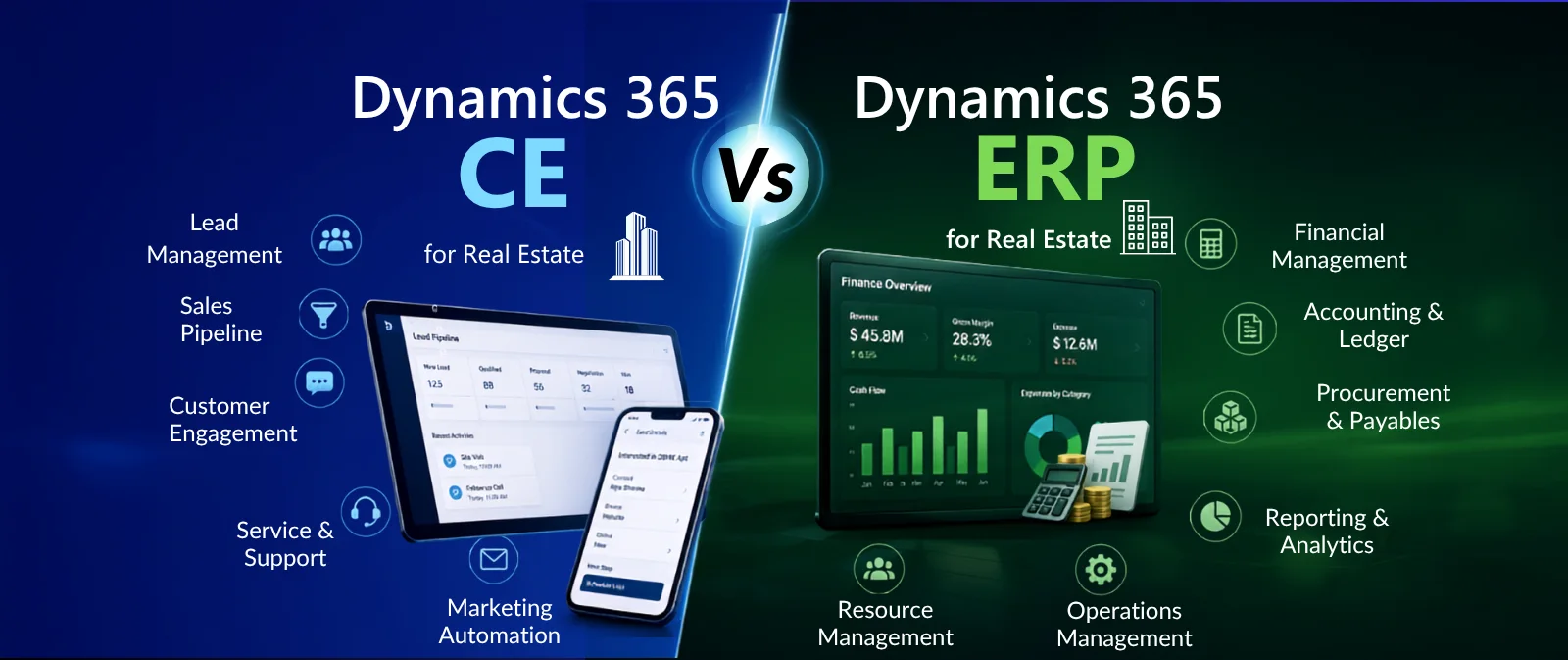
A real estate solution can be built on two different Microsoft Dynamics foundations. The first is the CRM platform, Dynamics 365 CE (Customer Engagement), built around managing customers through applications like Sales, Customer Service, and Field Service. The second is the ERP platform, Dynamics 365 Finance & Operations(F&O) for enterprises or Business Central for smaller organisations. (Throughout this blog, references to F&O mean Microsoft’s enterprise ERP platform, Dynamics 365 Finance & Operations.) These are finance-first systems that also include a sales and marketing module, which can be configured to handle CRM functions. This is how an ERP gets extended into a real estate solution. Both can therefore run a real estate business, and both have real deployments behind them. For over two decades, real estate has been the single focus of Metadata Technologies, with 100+ implementations across 12+ countries, 70+ certified professionals, and clients who stay for more than five years on average. This piece draws on that experience to explain what each platform represents and how it fits the way a real estate portfolio actually runs, so you can evaluate the choice for your business.
Key Takeaways
- A real estate solution can be built on Dynamics 365 CE (the customer engagement platform) or Dynamics 365 F&O (the finance platform), and that foundation shapes how the system works for every team that uses it.
- Dynamics 365 F&O is a strong finance engine and belongs in the architecture as the ERP, which is a separate question from what the CRM itself should be built on.
- Across sales, leasing, and facilities management, the same pattern holds: the financial step belongs in the ERP, and the customer-facing work belongs on a CE foundation.
- A real estate solution built on either foundation has its own strengths and limitations, so the right choice is less about which platform is better and more about which fits your portfolio and the way your business operates.
- A real estate solution built on CE keeps existing finance capabilities fully intact through a two-way ERP integration, whether the ERP runs on Microsoft, SAP, or Oracle, so it is not a trade-off between operations and finance.
Most real estate enterprises evaluating Microsoft Dynamics have already settled the question that matters most. They want to build on Microsoft. The platform is proven, the ecosystem is deep, and native integration with Outlook, Teams, SharePoint, and Power BI removes a whole category of problems before a project even begins.
The harder question comes next, and many buyers get it wrong. A real estate solution can be built on two very different Dynamics foundations: Dynamics 365 Customer Engagement (CE), the relationship-first platform, or Dynamics 365 Finance & Operations (F&O), the finance-first platform. Both can be turned into a real estate solution, and both have vendors and live deployments behind them. But they rest on opposite philosophies, and that foundation decides how the system feels every day for the people selling units, managing tenants, and running facilities. So the important question is which of the two your real estate solution should be built on, the engagement side or the finance side.
There is no single right answer, and that is the point. A solution built on either foundation has its own strengths and limitations, and the better fit depends on how your business is weighted. Some companies are built to sell, others are built to lease, many do both, and most also carry service and maintenance, where facilities management lives. That mix varies from one company to the next, and it is what should decide the platform, not the platform’s reputation on its own. This piece walks through how each foundation behaves across these core functions, so you can weigh the choice against your own portfolio.
Two foundations, Two outcomes
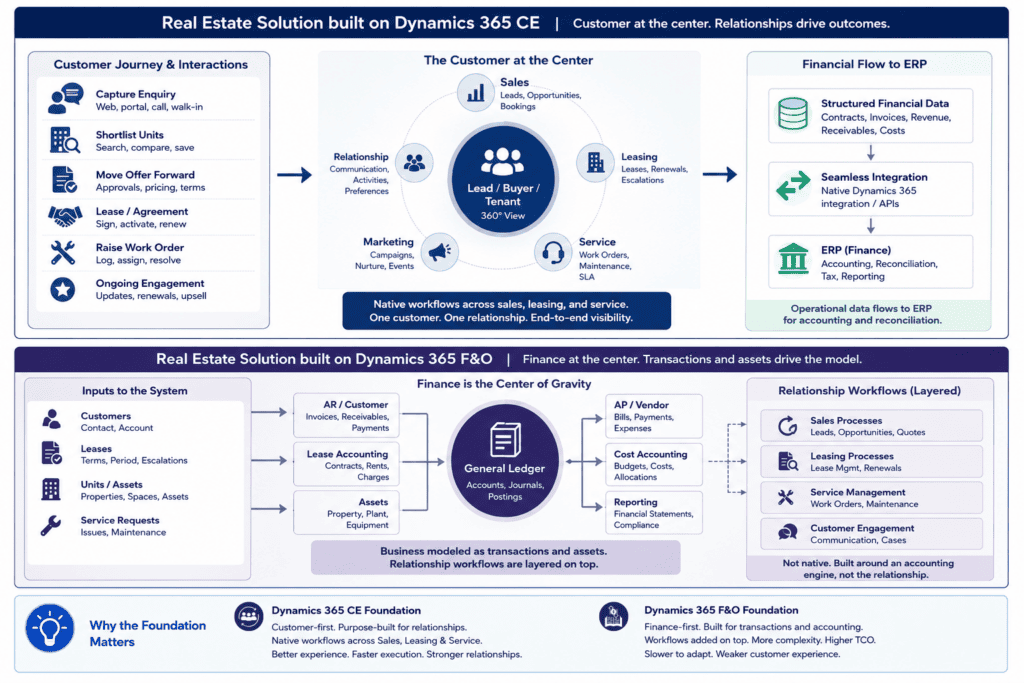
A Real Estate Solution built on Dynamics 365 CE follows the customer and every interaction with them, across sales, leasing, and service alike. The lead, the buyer, the tenant sits at the center. Capturing an enquiry, shortlisting units, moving an offer through approval, renewing a lease, raising a work order all run as native workflows. Structured financial data flows to the ERP for accounting and reconciliation.
A Real Estate Solution built on Dynamics 365 F&O treats the business as a series of transactions and assets. Finance is the center of gravity. Customers, leases, and units are modeled as inputs to ledgers and invoices, and the relationship workflows are layered on top of an accounting engine that was never designed for them.
The instinct of many buyers is to assume the foundation does not matter much, that a CRM is a CRM. It matters enormously, and the clearest way to see it is to walk through the three functions that define a real estate operation: sales, leasing, and facilities management. First, let’s see what the F&O Foundation does well.
Where F&O is strong
Dismissing the F&O foundation would be a mistake, because as a financial engine, it is genuinely strong.
For collections, receipts, invoicing, ledgers, statements of account, multi-entity consolidation, and audited reporting, F&O is built for exactly this work. ERP platforms are designed around accounting principles that are deliberately rigid, because financial rules are not meant to bend for convenience. For some real estate businesses, especially large asset owners, the toughest part of the day is the accounting work, and for them a strong finance system is a must.
Here is the part that gets missed. None of that is an argument for building the Real Estate Solution on F&O. It is an argument for keeping a strong ERP in the architecture. The financial depth a business values does not need to be the foundation of its customer operations to remain available. It only needs to be connected to them. The three functions below show why.
CE vs F&O across Sales, Leasing, and Facilities Management
Sales
Real estate sales is a fast-moving relationship process. A lead arrives, gets qualified, is matched to available inventory, moves through an offer and booking, and converts to a unit sale. Speed and flexibility decide how many leads become bookings.
Real estate sales journey, on two foundations
| Stage | Real Estate Solution built on Dynamics 365 CE | Real Estate Solution built on Dynamics 365 F&O |
| Lead | Captured from portal or broker, auto-assigned and qualified | Basic capture, manual routing, weak source tracking |
| Offer | Booking created, approved, document checklist generated | Approval and document steps hard to configure |
| Unit Sale | Sale executed; payment and receipt data sent to the ERP ⟷ | Native here; the ledger is home ground |
| Post-Sale | Transfers, variations, cancellations tracked on the customer record | Financial events clean; relationship events weak |
| Where F&O breaks: the sales team works inside a system built for accounting. Lead capture and follow-up are weak, and every campaign change becomes a customisation. |
The financial step is handled well on both, because that is what the ERP is for. Everything before it, the part that wins the deal, is where the F&O foundation slows the sales team down. Few buyers dispute this. The next function is where the real debate lives.
Leasing
Leasing is often described as operations- and finance-heavy, which is why it is commonly assumed that a real estate solution built on F&O is the natural fit. There is real truth in that. A large part of leasing is financial and operational work: rent invoicing, receipts, settlements, and reporting, all of which F&O handles well within a single system.
But leasing also has a customer and service side. A tenant enquiry is captured and qualified, units are shortlisted against availability, an offer becomes a tenancy agreement, and once the lease is live, the relationship continues through renewals, extensions, terminations, and a steady flow of tenant service requests. How much that customer-facing work matters varies from one operator to the next, and that is what makes the platform choice genuinely situational rather than settled.
For some leasing businesses, the work before and after the contract is light. Occupancy is stable, tenants are long-term, enquiries are limited, and renewals are largely routine. For an operator like this, most of the daily load sits on the financial side, and a solution built on F&O can be a strong fit, keeping everything in one system and handling the lighter relationship needs through sales and marketing modules within F&O itself, with no second platform to run.
For other leasing businesses, that customer-facing work is central and active. Enquiries arrive in volume and compete for units, shortlisting depends on live availability, renewals have to be worked to protect occupancy, and tenants raise service requests that need routing, tracking, and resolution. For an operator like this, the same customer-side strengths that matter in sales matter just as much in leasing, with the financial steps handed off to the ERP.
Leasing journey, on two foundations (residential, commercial, retail):
| Stage | Real Estate Solution built on Dynamics 365 CE | Real Estate Solution built on Dynamics 365 F&O |
| Lead | Tenant enquiry captured, qualified, and routed | Basic prospect capture; limited qualification and routing |
| Offer | Units shortlisted on live availability; offer approved through workflow | Units modeled as items or assets; shortlisting simpler and less dynamic |
| Unit Lease | Lease executed; payment and receipt data sent to the ERP ⟷ | Payment and receipts handled natively in the ERP |
| Post-Leasing | Renewals, extensions, terminations, settlements, and tenant service are tracked as workflows and cases | Financial events handled cleanly; renewals and tenant service managed manually |
| Where F&O breaks: the customer and service layer is thin. There is no native case management for tenant requests, no built-in scheduling for maintenance, and lead and enquiry handling is basic, so those run manually or through a custom build. How much that matters depends on how central that work is to the way the business runs. |
The point is not that one foundation is right and the other wrong. It is that leasing means different things to different operators. Where the value sits mostly in stable, long-term tenancies and clean financial management, a solution built on F&O can serve that model well. Where the value depends on actively winning, serving, and retaining tenants, a solution built on CE is designed for that work, with finance handled through the ERP. The right choice follows your portfolio and how your business actually runs.
Facilities management
Facilities management looks operational, but at its core, it is service delivery, and service is a relationship. A request comes in, gets prioritised and scheduled, a technician is dispatched, the job is done and closed, and the financial side, billing the work as a sales order, hands off to the ERP.
Facilities management work order, on two foundations
| Stage | Real Estate Solution built on Dynamics 365 CE | Real Estate Solution built on Dynamics 365 F&O |
| Create | Request logged with priority, SLA, and category | Logged as a transaction; weak SLA and triage logic |
| Schedule | Schedule assistant assigns the right resource; auto-notify | Manual assignment; no native scheduling engine |
| Issue | Auto-SLA, spare parts, and service handled in the field | SLA tracking and field workflow are not native |
| Close | Multi-level approval; work billed as a sales order to the ERP ⟷ | Billing is handled here in the ERP |
| Where F&O breaks: no native scheduling or SLA engine, no real field-service workflow, so technicians and dispatchers lose the visibility that keeps service on time. |
The pattern repeats a third time. The financial close belongs in the ERP, and a CE-built CRM sends it there. Everything that determines whether the tenant gets good service, triage, scheduling, SLAs, field execution, needs the engagement foundation.
What this means for your foundation
Across all three functions, the same shape appears. The financial step, the sale, the lease, the billed work order, is handled by the ERP, and a CE-built Solution passes clean data to it. Everything around that step, the work of winning, keeping, and serving customers, is where the F&O foundation turns a relationship process into a back-office chore.
So for a real estate enterprise running any mix of sales, leasing, and facilities, a Real Estate Solution built on Dynamics CE, connected to the finance system through a clean two-way integration, serves the whole operation better than a Real Estate Solution built on F&O. It is not a trade-off between operations and finance. The CE-built CRM runs the customer-facing lifecycle, your ERP keeps doing the accounting, and the two work as one. A well-built CE-based real estate CRM integrates with any ERP, whether that is Dynamics 365 F&O, SAP, Oracle, or another platform, so a prior ERP investment is preserved, not replaced.
The integration is what makes that picture whole, and it is the part worth scrutinising closely before choosing a partner, because a CRM and an ERP that do not reconcile cleanly create more problems than they solve. Before shortlisting any vendor, it is worth working through the integration-risk questions every CIO and CTO should ask.
CE vs. F&O at a glance
| Capability | Real Estate Solution built on Dynamics 365 CE | Real Estate Solution built on Dynamics 365 F&O |
| Foundation philosophy | Customer Relationships and Lifecycles | Transactions and accounting |
| Lead & enquiry management | Native: capture, routing, qualification | Limited; not a core strength |
| Unit availability & shortlisting | Real-time, no double-booking | Units modeled as assets, not live stock |
| Sales & leasing workflows | Configurable: renewals, terminations | Rigid; finance-grade, hard to customize |
| Tenant & FM service | Native case management, SLAs, scheduling | Bolt-on; weak for service lifecycle |
| Marketing & campaigns | Full automation, segmentation | Limited; not designed for outreach |
| Financial management | Connects to the ERP for accounting | Deep: ledgers, collections, settlements |
| ERP integration | Two-way with D365 F&O, SAP, Oracle, others | CRM and ERP is same platform with no separate logic |
| Reporting | Pipeline, occupancy, renewals via Power BI | Financial and operational metrics |
| User experience | Built for sales, leasing, and FM teams | Built for finance and back-office |
Conclusion
The choice between a Real Estate Solution built on Dynamics CE and one built on Dynamics F&O is a choice between two foundations: customer relationships at the center with finance connected, or finance at the center with customer relationships bolted on. Across sales, leasing, and facilities, the same truth holds. The financial step belongs in the ERP, and everything else belongs on a platform built for customers. For most developers and mixed-portfolio enterprises, that points to CE.
The reassuring part is that choosing the CE foundation costs nothing on the finance side. With the right two-way ERP integration, financial functions stay fully intact, whether they run on Microsoft, SAP, or Oracle. Sales, leasing, and operations simply move onto a platform built for them.
Still weighing F&O against Dynamics CE?
The right foundation depends on:
- How your business actually runs
- Your mix of sales, leasing, operations, and facilities management
- The ERP you already have
Real estate is the only field we work in, and have for over two decades, across 100+ implementations in 12+ countries, with 70+ certified professionals and clients who stay with us for more than five years on average. That focus is what led us to build Property-xRM on Dynamics 365 CE, a complete real estate suite that runs the full customer-facing side of the business, from first enquiry through to ongoing service, while connecting to whatever ERP sits behind it, whether that is Dynamics F&O, SAP, Oracle, or another system.
Wherever you are in the decision, a short conversation is the best place to start.
FAQ
Is the “CRM module” inside Dynamics 365 F&O the same as a CRM built on Dynamics 365 CE?
No, and this is a frequent source of confusion. F&O has some customer and account functionality, but it is not a customer engagement platform. The CE applications, Sales, Customer Service, and Field Service, are purpose-built for managing relationships, pipelines, and service, and they run on a different data model. A real estate CRM built on CE draws on that engagement capability; a “CRM” assembled inside F&O is working against the grain of an accounting system.
Which Dynamics 365 modules does a real estate CRM actually use?
A CE-based real estate CRM typically draws on Dynamics 365 Sales for pipeline and lead management, Customer Service for case management and tenant service, Field Service for facilities work orders, and the marketing app (now called Customer Insights – Journeys) for campaigns and lead attribution. None of these are real estate-specific on their own, so a real estate CRM adds the industry functionality on top: unit inventory, leasing cycles, broker management, and owner association. Property-xRM is one such product, built on these CE applications. F&O, by contrast, contributes to the finance and operations side, which is why it belongs in the architecture as the ERP rather than as the CRM.
Does a CE-based CRM cost more than running everything on F&O?
Licensing works differently for each, and F&O’s per-user ERP licensing is generally the more expensive of the two, so a CE-based CRM connected to your existing ERP is not automatically the costlier route. The larger cost question is usually customisation: forcing customer-facing workflows onto F&O tends to generate ongoing configuration and consultant work, which often outweighs licensing differences over time. The right comparison is total cost over a few years, not the headline per-user price.
We’re already on an F&O-based real estate system. Is migrating to a CE-based CRM disruptive?
It is a real project, but a contained one, because you are not replacing your finance system, only moving the customer-facing operations onto a platform built for them. The main work is data migration, mapping records cleanly, and re-establishing the integration to your ERP. The finance core you already rely on stays in place, which keeps the scope and the risk narrower than a full platform replacement.
Can one Dynamics 365 package cover sales, service, and accounting together, or do they come separately?
Dynamics 365 is a suite of separate applications rather than a single product, so the CRM apps (CE) and the ERP apps (F&O or Business Central) are licensed and deployed individually and then connected. For real estate, the practical pattern is a CE-based CRM for customer operations linked to an ERP for accounting, rather than one monolithic package doing everything. A partner usually helps assemble the right combination for the business.
On the Microsoft stack, do CE and F&O share data automatically?
They can. Within Microsoft, CE and F&O sit on a common data foundation and connect through Microsoft’s native two-way synchronisation, so customer, order, and invoice data can move between them without custom middleware. It still needs to be set up and governed properly, but the building blocks for a clean CRM-to-ERP link are part of the platform rather than something bolted on afterwards.
Is it better to roll out the finance system first and add the CRM later?
Some implementation guidance suggests starting with finance and lease administration, then layering CRM on afterward. The sequencing depends on where the business is losing the most time today: if customer operations are the bottleneck, leading with the CE-based CRM makes sense; if financial reporting is the urgent gap, the ERP may come first. The order matters less than ensuring the two are designed to integrate cleanly from the start, since retrofitting an integration later tends to cost more.
Is Dynamics 365 F&O better for leasing and property management because they are more operations-heavy?
This is a common assumption, but it does not hold up. Leasing and property management involve a great deal of relationship and service work, enquiries, shortlisting, approvals, renewals, terminations, and tenant requests, with a financial step at the end. That financial step belongs in the ERP, but everything around it is the kind of customer-facing workflow a CE foundation handles natively. Even in leasing, the stronger pattern is CE running the lifecycle and the ERP handling the finance.
What does it actually mean that a real estate CRM is “listed on Microsoft AppSource”?
An AppSource listing means the solution has been submitted to Microsoft’s marketplace and passed its technical verification, so the code has been reviewed against Microsoft standards rather than simply self-published. For a real estate buyer, it is a signal that the solution is a maintained product with an owner responsible for keeping it current with the Dynamics platform, not a one-off custom build. It is one of several partner-quality indicators worth checking, alongside implementation track record and references.
There are several real estate solutions on Dynamics 365. How do I tell a genuine product from a custom build with a real estate label?
The key distinction is whether the real estate functionality is delivered as a maintained product or assembled as bespoke customisation on a generic platform. A genuine product codifies unit inventory, leasing, facilities, and broker workflows as reusable functionality with a roadmap and upgrade path; a custom build approximates the same things through one-off configuration that the buyer then has to maintain. Asking how many times the solution has been implemented and whether it carries an AppSource listing and a published roadmap quickly separates the two. Property-xRM, for instance, is delivered as an AppSource-listed product rather than a custom build, which places it in the first category.

 Apr 19, 2022