
A real estate project launch is built to look effortless from the front. A scale model of the development sits at the centre of the venue as the showstopper; brokers arrive with their clients, VIPs are greeted personally, and light entertainment sets the tone while the room fills. Behind that front stage, a different process is running. Within the opening hour, hundreds of walk-in buyers, invited guests, and brokers arrive at once, against a small sales team and a fixed inventory pool. Some arrive with a pre-registered invitation, others walk in without one, and each still has to be verified, matched to the right account, and placed into a queue before a sales agent ever sees them. As volume builds, holding that process together gets harder by the hour, and by midday the sales team is moving faster than any manual process can reliably track. What that costs a launch is where this piece picks up next.
Key Takeaways
- A launch is built to look effortless from the front: a scale model as the centrepiece, VIPs greeted personally, brokers moving through with clients, entertainment setting the tone, but behind that stage, a separate operational process is running, and it is where the real problems start.
- These problems show up mainly at scale. A launch with fifty buyers can run fine. The same launch with five hundred buyers can fall apart, not because the sales team is worse, but because nothing is enforcing the rules once things get busy.
- Five gaps cause most of the trouble: unreliable registration, no clear queue order, units getting sold twice, payment plans applied unevenly, and no record of what actually happened.
- Left alone, these gaps don’t stay separate. One small problem leads to the next, until a single dispute turns into lost revenue, a compliance issue, or damage to buyer and broker trust.
- Closing these gaps is not a matter of effort. It is a matter of governance, and which single point breaks first differs from one launch to the next.
The Five Reasons Real Estate Project Launches Fail at Scale
Reason 1: No fair prioritization
Once a buyer registers, whether through a pre-registered invitation or as a walk-in, sales operations verify that registration and places it into a queue. Verification is also where legitimate priority gets applied: a VIP walk-in, or a guest arriving later than scheduled, can be moved ahead of the standard order. That override is meant to be the exception, applied for a specific, verifiable reason, not the default.
Without a governed process behind it, this distinction collapses. A sales agent under pressure from a persistent buyer, or a manager asked to make an exception for a broker relationship, ends up deciding priority informally, case by case, with no record of why. Each exception may look reasonable on its own. Collectively, they are indistinguishable from favoritism to everyone else standing in line. This is where broker trust erodes fastest, since brokers compare notes on how their clients were treated relative to others. Registration is also where a broker is formally linked to the buyer, either an existing broker record in the system or a new one created on the spot, so the referral itself becomes part of the record from the first minute, not something reconstructed later.
Reason 2: Inventory conflicts and overbooking
A unit shown as available to one agent needs to be unavailable to every other agent the instant it is selected. At volume, with multiple agents working multiple buyers simultaneously across the same inventory pool, this is difficult to guarantee without a system enforcing it in real time.
Without real-time locking, two agents can advance two different buyers on the same unit at the same time, each unaware of the other’s progress, until both arrive at a signed offer. This is not a rare mistake made by careless staff. It becomes a near-certain outcome once the number of concurrent agents and buyers crosses a threshold that memory-based coordination cannot cover. The resulting dispute, two legitimate-seeming claims on one unit, has no clean resolution, only a difficult conversation and a damaged relationship with at least one buyer.
Many launches also release inventory in phases rather than all at once, opening a limited set of units first and adding more as demand becomes clear, adjusting price along the way. That strategy depends entirely on real-time visibility into what has actually sold. Without it, sales leadership is deciding when to release the next phase, and at what price, based on incomplete or delayed information.
Reason 3: Manual tokening and queues
Registration is where a launch establishes who a buyer actually is. An invited guest can typically be found through a QR code from their invitation. A walk-in has no such record and needs a registration created on the spot, along with a token generated at that moment. Done well, this step also checks whether the person already exists in the system as a contact or account, so the same buyer isn’t registered twice under two different records, and captures which broker, if any, referred them.
Run on a sign-in sheet or a spreadsheet at a welcome desk, none of this holds at volume. A hostess working from memory and a printed guest list has no dependable way to confirm whether a walk-in was actually pre-invited, whether they already exist in the system under a different visit, or which broker should be credited. Once that first classification is unreliable, every downstream decision inherits the error. Most queue disputes on launch day trace back to this point, not to the queue itself.
Reason 4: Inconsistent payment plan application
Every launch shortlists a specific set of approved payment plan templates that agents are meant to use, and every offer created against a unit is meant to move through the same approval process before it’s confirmed. Discounting itself is typically discouraged at this stage, since launch pricing is usually already set to be competitive. The real risk is inconsistency in which approved plan gets applied to which buyer, and whether every offer actually goes through approval before a payment schedule is generated.
Without a system enforcing which templates are valid for a given launch, agents apply plans from memory or habit rather than the shortlisted set, and offers can move forward with approval steps skipped under time pressure. Both outcomes stay invisible until financial reconciliation happens after the event, by which point the exposure is already booked. This produces two costs at once: pricing inconsistency across buyers in the same category, and a compliance question about why the approval process wasn’t followed uniformly.
Reason 5: Limited auditability after launch
Every decision made on launch day, which payment plan template was applied to an offer, whether that offer actually cleared approval before a payment schedule was generated, which agent locked which unit, when a registration was verified, needs to be logged in a form that can be reconstructed later. Not because disputes are expected, but because at this volume, some will happen regardless of how well everything else runs.
That chain doesn’t end at the offer. Once an offer is generated, finance still has to create a receipt against it, and if the buyer came through an EOI, that receipt needs to be linked back to the EOI record. If an earlier step wasn’t clearly logged, whether a registration was actually verified, whether an offer actually cleared approval, this reconciliation step inherits the gap rather than catching it.
Without a logged record, a dispute raised weeks after the event has nothing to be resolved against. Leadership asked to explain what happened on launch day is reconstructing events from memory and fragments, not from a record. This is the gap that matters least in the moment and most in the weeks after, when a regulator, an auditor, or an unhappy buyer asks a specific question the organization cannot specifically answer.
Why these five reasons compound, not just add up
None of these five reasons fails in isolation at real volume. An unreliable registration feeds a queue dispute. A queue dispute pressures an agent into an inventory decision made too quickly. That decision, absent a locking mechanism, becomes a double-booked unit. The double booking, absent a traceable record, becomes an unresolvable dispute. Each gap does not simply add to the others; it multiplies the exposure created by the rest.
A booking made on launch day doesn’t end the record-keeping. The lead qualifies automatically, and the opportunity, contact, and account records generate from it without manual re-entry, carrying the buyer’s history forward intact rather than starting a fresh file downstream.
These same gaps do not stop mattering once the event ends, either. A buyer who reserved a unit under a specific payment plan carries that plan through construction-period payment milestones and into handover. If the registration, pricing, and inventory data captured on launch day does not carry forward cleanly, the same coordination gaps resurface later in the relationship, only with a buyer who has already committed capital and expects consistency. This is the throughline in how developers manage the full arc from first lead to completed handover: a launch that cannot hold its own five reasons together is unlikely to hold together everything that comes after it.
How each of the five reasons gets solved with a centralised CRM system in place
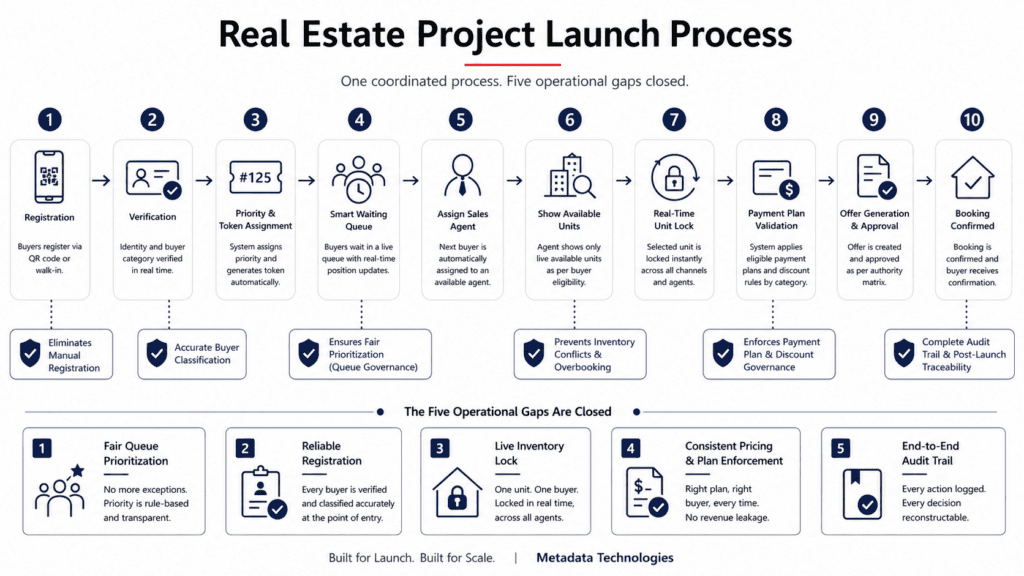
The diagram above is what these five reasons look like once they are solved, as one coordinated process rather than five separate points of failure.
None of the five reasons above get solved by working harder or hiring more staff. Each one is a coordination problem that exceeds what memory, goodwill, and a printed guest list can hold once volume crosses a threshold. That is what a system is for: not to replace the sales team, but to enforce the rules the team cannot reliably enforce on its own once hundreds of buyers are moving through the process at once.
Generic technology gets partway there. A spreadsheet or a basic contact tool can log a name. It cannot lock a unit in real time across every agent on the floor, gate a payment plan by buyer category, or generate an audit trail automatically as a byproduct of the process running. That level of enforcement is what an enterprise CRM is built for. And a launch specifically, with hundreds of buyers, multiple brokers, and a fixed inventory pool all moving at once, is exactly the scenario a generic CRM configured for another industry was never built to handle. It takes a CRM configured specifically for real estate, and for the scale a multi-million dollar launch actually operates at, to close all five reasons rather than one or two of them.
Each of the five reasons has its own specific fix within that system. None of them are solved by the same generic mechanism, and each is worth stating in terms of the business outcome it protects, not the software behind it.
Fair, rule-based prioritization
A CRM ties this to the registration step itself: an invited guest is matched instantly through a QR code from their invitation, and a walk-in is issued a token the moment they’re registered, which is what determines their queue position from that point forward. Every buyer is placed into a governed tier, and every buyer in that tier is served by the same rule, regardless of who is asking for an exception. Brokers see consistent treatment across every client, which is what protects the channel relationship long after launch day ends. That same broker link carries forward automatically once a booking is created, mapped directly to the resulting opportunity and offer, so commission and referral credit are never dependent on someone remembering to record it after the fact.
Protected inventory, no double-selling
A CRM makes a sold or selected unit unavailable to every other agent the instant it is chosen. Two agents can no longer advance two buyers on the same unit at once. This same real-time visibility is what makes a phased release workable in practice. A developer can open a defined first phase, for example, units up to floor 3, and the system shows exactly how much of that phase has sold at any moment, not an end-of-day estimate. Once uptake against that phase crosses whatever threshold sales leadership has set, releasing the next phase, and adjusting price for it, becomes a decision based on live sell-through, not a guess made from partial information gathered manually across agents and desks. This protects revenue directly: a double-booked unit is a cancelled sale and a damaged buyer relationship, and a phase released too early or priced without knowing real uptake is a pricing decision made blind, both of which a governed system removes as a possibility altogether.
A verified, trustworthy queue from the first minute
A CRM captures registration once, ties it to a verified record, and carries that record through the entire queue. There is no dependence on a hostess’s memory or a printed guest list to establish who a buyer is. This is what keeps the queue itself credible, since every dispute about priority traces back to whether registration was trustworthy in the first place.
Consistent pricing across every buyer, every agent
A CRM restricts agents to only the payment plan templates shortlisted and approved for that specific launch. A walk-in buyer registered in the general public category, for example, simply won’t see a VIP-tier plan as an option on their offer screen, regardless of what the agent intends. Every offer also has to clear the same approval step before a payment schedule can be generated, so an offer can’t move forward on a skipped or bypassed approval under time pressure. No agent, however much pressure they are under, can apply a plan outside that approved set or push an offer past approval, because the system does not allow either action. This protects both pricing consistency across the launch and the organization’s exposure to a compliance question later.
A record leadership can stand behind
A CRM logs every registration, lock, approval, and booking automatically as it happens. When a dispute is raised weeks later, or a regulator asks a specific question, leadership has an actual record to answer from, not a reconstruction from memory. This is what protects the organization’s credibility long after the launch itself is over.
Before and After an Enterprise CRM
| Failure Point | Without an Enterprise CRM | With an Enterprise CRM |
| No fair prioritization | Priority gets decided case by case at the desk, under pressure, indistinguishable from favoritism to the buyer standing behind the one who got the exception | Buyers are routed automatically into governed tiers (Private, Priority, Public), with the same rule applied to every buyer in a category |
| Inventory conflicts and overbooking | Two agents can advance two different buyers on the same unit simultaneously, unaware of each other, until both reach a signed offer | The unit locks in real time the instant it is selected, visible immediately to every agent working the floor |
| Manual tokening and queues | Registration and sequencing run on a sign-in sheet or spreadsheet, which breaks down structurally once volume exceeds what memory can track | Tokens generate automatically, timestamped and sequenced, tied to a single verified registration record |
| Inconsistent payment plan application | Discounting and plan eligibility depend on individual agent discretion, invisible until reconciliation happens after the event | Payment plans filter automatically by customer category, with no exceptions possible without a logged approval |
| Limited auditability | No record of who approved what, or when, so a dispute raised weeks later has nothing to be resolved against | Every action, registration, lock, approval, is logged automatically, giving leadership a full, reconstructable record |
Conclusion
A launch is one of the clearest tests an organization gives itself. It reveals, in a single compressed event, whether the operational infrastructure underneath the sales team can hold under pressure or whether it depends on individual heroics to get through the day. Each of the five reasons above has its own specific fix, and together they turn a launch from an event the organization survives into one it controls.
| Talk to a Team That Has Seen This Pattern Before |
| Real estate is the only business Metadata Technologies has ever worked in. That focus has produced more than 100 implementations across over 12 countries, supported by more than 70 certified professionals, with an average client tenure of over five years. Developers thinking through how their own launch process would hold up are welcome to talk it through with a team that has seen this pattern before, across markets and at scale. |
FAQ
Why is a CRM critical for a real estate project launch?
A launch concentrates months of demand into hours, across hundreds of buyers competing for finite inventory. A CRM is what allows the five reasons above, registration, queue prioritization, inventory locking, pricing governance, and traceability, to be closed consistently rather than left to individual judgment under pressure.
How does a CRM improve lead management during a real estate project launch?
Beyond tracking a lead through a pipeline, a CRM ties a buyer’s registration, category, and eligible payment plans to a single verified record from the first interaction. That record follows the buyer through queue routing, unit selection, and offer, so no stage of the process is working from incomplete or conflicting information about who the buyer is and what they qualify for.
How does a CRM increase sales conversion during a real estate launch?
Conversion depends less on any single agent’s persuasion and more on whether the process avoids losing buyers to friction: a long, unverifiable wait, a unit that turns out to already be sold, or a payment plan applied inconsistently. A CRM does not sell on the agent’s behalf. It removes the structural friction that would otherwise cost sales regardless of how skilled the agent is.
What are the key benefits of using CRM software for new property developments?
The benefit is consistency at volume. A new development launch runs the same five risks regardless of market or asset type: unreliable registration, ungoverned prioritization, unlocked inventory, inconsistent pricing, and no auditable record. A CRM closes all five simultaneously rather than requiring a separate manual fix for each.
What are the essential features of a CRM platform for managing a real estate launch sales pipeline?
Five capabilities matter most: a verified registration record established at first contact, rule-based queue prioritization, real-time inventory locking, payment plan eligibility gated by buyer category, and automatic audit logging. A platform missing any one of these leaves the corresponding failure point open.
How does a CRM streamline communication across a real estate launch team?
A launch typically runs across separate functions, front-desk registration, sales operations verification, and the agents closing deals, each historically working from separate records. A CRM ties these to one verified buyer record that updates in real time, so a change made at registration or in the queue is immediately visible to the agent handling that buyer, rather than communicated manually between desks.
How does a CRM help real estate teams track customer interactions during a launch?
Every interaction, from initial registration through queue status, unit selection, and offer, attaches to the same buyer record automatically. This gives a team visibility into where a specific buyer is in the process at any point, without depending on an agent’s memory or a manual handoff between roles.

 Apr 19, 2022