
Most APAC property developers run each launch as if it were their first. The team prepares the same way, briefs brokers the same way, and prices the campaign the same way, with refinements at the margins based on what felt like it worked last time.
The developers consistently improving their conversion rate launch after launch are doing something different. They are treating each completed project as a data source for the next one. The channel that underperformed, the pipeline stage where leads concentrated, the broker relationships that converted consistently: all of that is recorded and analysed before the next launch brief is written.
The data exists in every launch. Which broker channels converted, which pipeline stages had the highest dropout, which unit types moved fastest, which buyer segments closed. Most of it is never formally analysed. The post-launch report covers what was sold, when, and at what price. It rarely covers what should change.
What Launch Data exists but does not get used
By the end of a typical APAC project launch, a developer has accumulated lead source data, stage-by-stage conversion rates, broker attribution records, unit absorption timelines, and buyer profile information. That data lives across the CRM, the finance system, and the broker briefing records.
In most organisations, that data is used to produce a launch completion report: total leads, total bookings, total sales, revenue against target. The report answers what happened. It does not address why certain channels outperformed, where leads were lost in the pipeline, or what the highest-converting broker relationships had in common.
The gap between what happened and what should change is where most APAC developers leave conversion improvement on the table. The data that would answer those questions was captured during the launch. It is sitting in the system. Nobody has been asked to turn it into a brief for the next team.
The channel performance retrospective
Channel attribution is the most immediately actionable data from a completed launch. Which broker sources produced the highest-volume leads? Which produced the highest-converting leads? Those two questions often have different answers, and the difference matters for how the next launch is resourced and briefed.
High-volume broker channels that produce low conversion typically have a briefing or qualification problem. Brokers are bringing leads that are not ready or not suitable for the product. The fix is a tighter brief and a more defined buyer profile, not more volume from the same source.
High-converting broker channels that produced low volume are the underinvestment signal. They exist in almost every completed launch. They represent broker relationships that responded to the product and the process, and that can be engaged more aggressively in the next project. Most sales directors know who these brokers are informally. The data makes the case for investing in them systematically.
Pipeline stage analysis
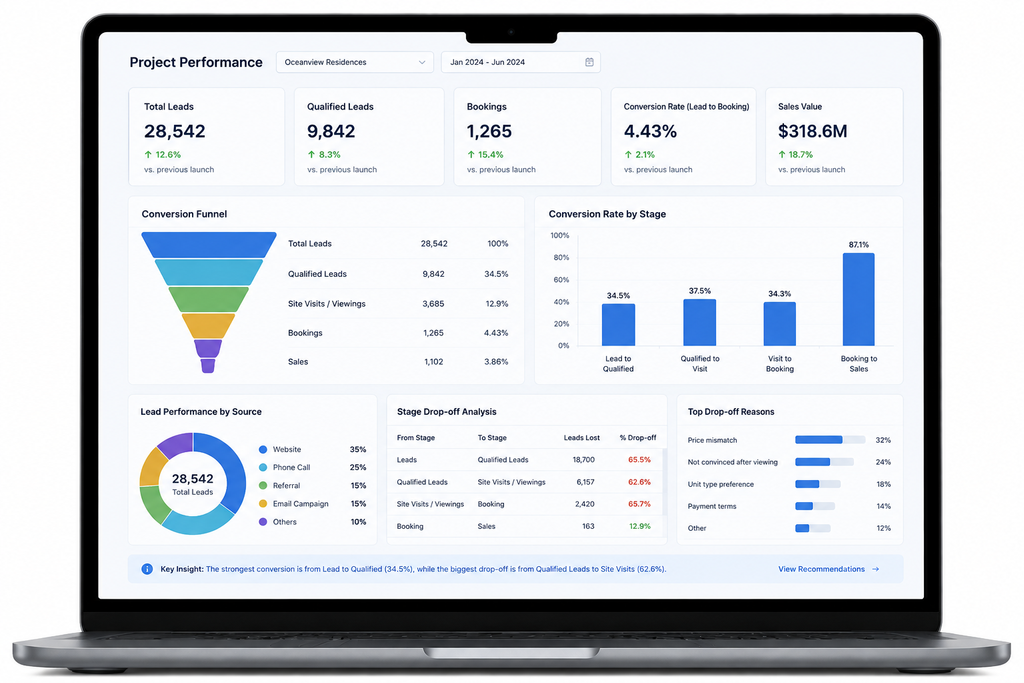
Overall conversion rate is a useful summary metric. Conversion rate by pipeline stage is where the actionable information sits.
A developer whose lead-to-viewing conversion is strong but whose viewing-to-booking rate is weak has a presentation or qualification problem, not a lead generation problem. The buyer is interested enough to view but not convinced enough to book. Spending more on lead generation does not fix that. Understanding what is happening in the viewing experience does.
Stage-level dropout analysis from each completed launch gives the next launch team a specific brief: this is where we lost the highest proportion of qualified leads, this is what we know about who was lost at that stage, this is what the next process needs to address differently. That is a materially better starting point than intuition and the most recent campaign.
Broker performance learnings
Not all broker relationships are equal, and not all high-performing broker relationships are obvious in advance. In every APAC launch, a small number of broker relationships drive a disproportionate share of conversion. Most developers identify these informally: the sales director knows who their top brokers are.
Formal broker performance data from a completed launch tells a more useful story. It shows which relationships converted consistently across unit types versus which produced one strong result that may not repeat. It shows which brokers responded to different briefing approaches and which required more direct relationship investment to produce results.
That data is the basis for a tiered broker engagement strategy in the next project. Instead of briefing the same broker network the same way, the next launch can apply differentiated investment based on demonstrated conversion history. The top tier gets early access, dedicated briefings, and performance incentives. The rest get standard treatment. The allocation is evidence-based rather than relational.
Building the retrospective into the launch cycle
For most APAC developers, the gap is not data. The gap is process. The data exists in the CRM. Nobody is accountable for turning it into a structured retrospective, and the team is already focused on the next launch before the current one has been properly closed.
The simplest version of a post-launch retrospective is a four-hour structured review, run against a fixed analytical template: channel attribution by conversion rate, stage-level conversion analysis, broker performance by tier, buyer profile analysis by unit type. The output is a one-page brief for the next launch team covering what to do differently and why.
The brief does not need to be comprehensive. It needs to be specific. Three things to do differently in the next launch, based on data from the last one, produces more value than a detailed report that nobody reads before the next briefing cycle begins.
How data compounds across launches
The value of post-launch analysis compounds over time. A developer with structured data from three completed launches knows significantly more about their market, their broker network, and their buyer segments than a developer relying on the most recent campaign and the sales director’s memory.
After three launches, patterns become visible that are not visible in any single project. Which buyer segments behave consistently across different project types. Which broker channels are reliable across different product configurations. Which pipeline stages have structural friction that is not project-specific and therefore requires a process change rather than a project-specific adjustment.
That accumulated knowledge is a competitive advantage that is difficult for competitors to replicate. It shows up as faster absorption rates, lower broker acquisition costs, and sales teams that spend less time diagnosing problems mid-launch because the process has already been refined across multiple cycles.
How Metadata Technologies helps Metadata Technologies captures stage-level conversion data, broker channel attribution, and buyer profile information across every launch in a format that supports post-launch retrospective analysis without manual data extraction. Sales directors can compare conversion rates by pipeline stage, broker source, unit type, and buyer segment across completed projects and use that data to shape briefing strategy, channel investment, and process design for the next launch. If you want to see what a launch retrospective looks like inside our platform, Talk to us and we will walk through the reporting layer with your team.



FAQ
What data from a completed launch is most useful for improving the next one?
Stage-level conversion rates, broker channel attribution by conversion rate (not just volume), buyer profile distribution by unit type and closing rate, and the timeline from first contact to booking by lead source. These four data sets, read together, typically reveal two or three specific changes that would have a material impact on conversion in the next launch. They are all producible from a CRM that has tracked the launch properly.
How should a post-launch retrospective be structured?
A structured retrospective covers four areas: channel performance (which sources produced the best conversion), pipeline analysis (where leads were lost and at what rate), broker review (which relationships converted consistently and which underperformed), and buyer profile analysis (what the highest-converting buyer segments had in common). The output should be a brief for the next launch team, not a comprehensive report. Specificity matters more than coverage.
How long after a launch should the retrospective be conducted?
The retrospective is most useful when conducted within four to six weeks of the launch closing or reaching a stable absorption plateau. Earlier than that, the data is incomplete. Later than that, the team has moved on and the next launch planning has already begun without the benefit of the analysis. Building the retrospective into the standard launch cycle as a fixed deliverable, rather than treating it as optional, is the most reliable way to ensure it happens.
How do you identify which broker relationships to invest in more heavily for the next launch?
The selection criterion should be conversion rate by broker, not lead volume. High-volume brokers who convert at below-average rates are typically generating unqualified interest that consumes sales team time without producing bookings. High-converting brokers who produced lower volume may have been under-briefed or under-incentivised. The retrospective should identify the top 10 to 15 percent of brokers by conversion rate and build a specific engagement plan around them for the next launch.
What CRM data needs to be captured during a launch to support post-launch analysis?
Stage-level progression for every lead, broker attribution on every lead from first contact through to booking, unit type preference and actual booking data for closed buyers, and the timeline between each stage transition. If the CRM is only capturing lead source and booking outcome, the stage-level data that makes retrospective analysis actionable is missing. The data capture design should be set up before the launch begins, not reconstructed from memory after it ends.
How do you ensure the retrospective findings are actually used in the next launch?
The retrospective brief should be a required input to the next launch planning process, not an optional reference document. The sales director or launch team lead should be able to explain how each specific retrospective finding has been addressed in the next launch brief. Where a finding has not been addressed, there should be a documented reason. Treating the retrospective as an accountability document rather than a learning exercise changes how teams engage with it.
Is post-launch analysis relevant for developers running concurrent projects rather than sequential ones?
Yes, and it is particularly valuable in a concurrent environment because learnings from one project can be applied to active projects that are still in early launch stages. Broker performance data from Project A can inform broker investment decisions for Project B that launched two months later. Stage-level conversion data from Project A can prompt process changes on Project B before the same dropout pattern repeats. Concurrent project environments have faster feedback loops if the retrospective process is structured to cross-reference projects rather than treating each in isolation.

 Apr 19, 2022