
Key takeaways
- A signed booking is not secured revenue. In GCC project sales, post-booking dropout is common, concentrated, and mostly invisible in standard sales reporting.
- The dropout is not a buyer commitment problem. It is a process problem: document collection friction, payment confirmation delays, and SPA timeline opacity are the three primary causes.
- Post-booking stages are tracked in most operations through WhatsApp threads and spreadsheets, which produce no data, no prompts, and no visibility for the sales manager.
- Teams with the lowest dropout rates treat the post-booking journey as a named pipeline stage with owners, timelines, and automated follow-up at each step.
- Once post-booking stages are tracked in the CRM, dropout concentration becomes visible within one launch cycle, and fixing one or two steps produces measurable improvement in the same launch.
A signed booking feels like secured revenue. In GCC project sales, it is not.
Between the booking form and the executed SPA, there is a process gap where confirmed sales quietly disappear. The buyer who was enthusiastic at signing is three weeks into a document collection exercise with no clear status update. By the time the SPA is ready, their commitment has cooled. The dropout is rarely dramatic. It accumulates across a launch.
Most sales teams track the top of the funnel with precision: enquiries, viewings, bookings. Very few have the same visibility into what happens after the booking is signed. The post-booking journey is where the conversion rate calculation ends for most reporting systems, and where revenue risk begins.
What the dropout looks like in practice
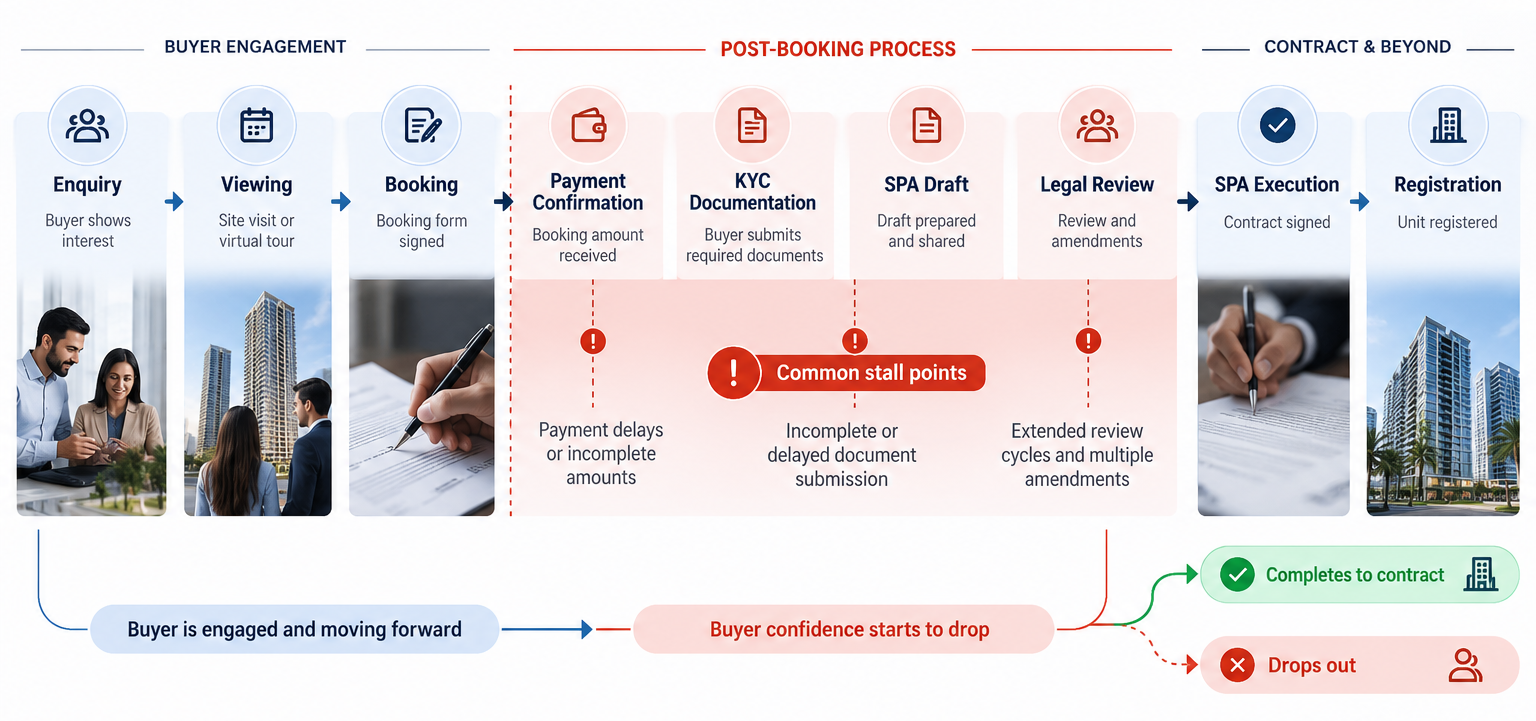
The typical GCC project sales booking-to-contract process involves five to eight steps: booking form receipt, payment confirmation, KYC documentation, SPA draft, legal review and amendments, SPA execution, and registration. Each step is a potential stall point. Each stall point extends the window in which buyer confidence erodes.
The buyer who completed a booking on a Saturday afternoon receives a document checklist on Monday. They are busy. The checklist has eight items. They upload three and intend to complete the rest later. Nobody follows up until the sales manager checks in two weeks later and finds the file incomplete. The buyer, who has now seen a competing project at a launch event, is no longer certain.
The dropout is rarely visible in aggregate reporting because it happens over weeks, not days. A booking that goes cold gets logged as uncontactable or under consideration rather than lost at document stage. The loss is real. The cause is invisible in every report the leadership team sees.
The cost of post-booking dropout
In a typical GCC launch of 200 units at an average value of AED 1.5 million, a post-booking dropout rate of 15 percent represents AED 45 million in revenue that was confirmed at booking and not converted to contract. That figure does not include the re-marketing cost of relaunching those units, the delay to revenue recognition, or the broker commission already paid on some of those bookings.
The calculation is rarely done because the dropout rate is rarely tracked as a distinct metric. Most GCC developer finance teams record the executed SPA as the point of sale and do not separate the booking-to-contract conversion rate from the overall pipeline conversion. The gap between those two numbers is where the hidden revenue loss sits.
A developer running four launches per year with a consistent 15 percent post-booking dropout is carrying a structural revenue gap that compounds with every launch. The marketing and broker investment at the top of the funnel keeps growing to compensate for a loss that occurs in the middle, at a stage that costs almost nothing to fix compared to the revenue it is absorbing.
Also read: 5 Reasons Real Estate Project Launches Fail at Scale
Where the process breaks
Document collection is the most common failure point. KYC requirements, passport copies, proof of funds, and corporate documents for entity buyers create a multi-step checklist. Without a structured follow-up process, the checklist stalls at whichever item is most inconvenient for the buyer to produce first. The average stall duration when follow-up is informal is 12 to 18 days. The average stall duration when follow-up is automated and tied to a 48-hour prompt is under four days.
Payment confirmation is the second failure point. The buyer has committed to a booking amount but the SPA cannot proceed until payment clears and is reconciled. Without automated payment monitoring and a follow-up trigger, the lag extends from two business days to two weeks, often longer for international transfers. During that window, the buyer is in a holding pattern with no communication and no sense of progress.
The SPA process itself adds timeline uncertainty that is rarely communicated to the buyer. Legal review, internal approvals, and amendment rounds are not visible to the sales team unless someone specifically asks. The buyer requests a status update. The salesperson asks the legal team. The buyer interprets the delay as disorganisation and starts looking at alternatives. In competitive GCC launch markets, that window is rarely empty.
What high-performing teams do differently
Teams with low booking-to-contract dropout treat the post-booking process as a pipeline stage, not an administrative tail. Every step has an owner, a target completion date, and a follow-up prompt. The sales manager can see at any moment which bookings are progressing, and which have stalled, and at which step. That visibility alone changes how the team allocates its attention during a launch.
Document collection runs from a structured checklist inside the CRM, not a WhatsApp thread. The buyer receives automated reminders at 48-hour intervals for any outstanding item. The salesperson receives a prompt when a file has been incomplete for more than five days. The follow-up is systematic rather than dependent on someone remembering to check.
Payment status is monitored in the same system as the sale record. When a payment clears, the next stage triggers. When a payment is overdue, the sales team is notified before the buyer must be chased, and before the SPA process is delayed by a payment that has not cleared. The buyer experiences the process as organised and attentive. That experience reduces the rate at which buyers reconsider.
The Data layer that makes dropout visible
Post-booking dropout is nearly invisible without stage-level tracking inside the CRM. Most sales reporting ends at booking volume. The stages between booking and contract execution are managed through email, WhatsApp, and a spreadsheet that someone updates when they have time. That approach produces no data, no prompts, and no visibility for the sales manager until a problem is already a week old.
When the post-booking stages are tracked in the CRM, the data starts to show where concentration of dropout sits. Some launches lose most of their post-booking dropout at the document collection stage. Others lose it at payment confirmation. Some have a specific unit type or payment structure that consistently produces longer timelines and higher dropout. None of that is visible without stage-level tracking.
That stage-level data is the basis for a faster and more reliable post-booking process. It turns a reactive problem into a manageable one. The same launch team that used to spend time chasing cold bookings can instead focus on the specific step where intervention produces the most recovery. The data shows where to act, not just that something is wrong.
Also Read: How to Use CRM Data and Analytics to Improve Real Estate Sales Performance
The compounding effect across Launches
Booking-to-contract dropout is not a one-launch problem. Developers who do not track post-booking stages carry the same structural gaps into every subsequent launch. The top of the funnel gets more investment each time: more lead generation, more broker briefings, more launch events. The post-booking gap absorbs a share of that investment quietly, without appearing in any report as the cause.
Developers who have mapped and measured the post-booking process find the same pattern: the dropout rate that seemed like market variability was concentrated at one or two specific steps. Once those steps were addressed, the change in confirmed revenue was meaningful without any increase in lead generation spend. The improvement compounded across subsequent launches because the infrastructure carried forward.
The investment in post-booking infrastructure pays forward. Every subsequent launch runs the same improved process. The compound effect of a higher booking-to-contract conversion rate, across multiple launches, exceeds the cost of the infrastructure many times over. And the data from each launch cycle improves the process further.
The right starting point
For most GCC developers, the first step is not a new system. It is mapping the current post-booking process and identifying which steps are tracked and which are not. That mapping exercise typically reveals the gap within a single afternoon, and it tells the operations team exactly which steps need structured follow-up before the next launch begins.
Adding stage tracking inside the existing CRM, even at a basic level, produces actionable data within one to two launch cycles. The fix follows the data. Most developers who have done this find the dropout is concentrated enough that addressing one or two steps in the process produces a measurable improvement in the same launch it is implemented. The process improvement is not a long programme. It is a series of small changes applied at the right stage.
How Metadata Technologies helps
Metadata Technologies builds the operational layer that GCC project sales teams need to track the full post-booking journey as a pipeline stage, not an administrative tail. Every step between booking confirmation and SPA execution has an owner, a timeline, and automated follow-up prompts built into the workflow.
Document collection runs from a structured checklist inside the platform. Payment status is monitored in the same system as the sale record. The sales team sees a live view of which bookings are progressing and which have stalled at which step.
If your team is managing post-booking follow-up through WhatsApp threads and shared spreadsheets, Talk to us. We can help you streamline the process and build a more structured, trackable post-booking workflow.



FAQ
What is a normal booking-to-contract conversion rate in GCC project sales?
Most GCC developers do not track this rate formally, which is itself part of the problem. In operations where the post-booking process is structured and tracked, booking-to-contract conversion rates of 85 to 95 percent are achievable on standard residential launches. Rates below 80 percent almost always indicate a specific process gap at document collection or payment confirmation rather than a buyer commitment issue.
What are the most common reasons buyers drop out between booking and SPA?
The three most common causes are document collection friction, payment processing delays, and perceived disorganisation on the developer side. Buyers who experience a slow or opaque post-booking process are more likely to reconsider during the wait. The dropout is rarely because the buyer changed their mind about the unit. It is because the process gave them time and reason to reconsider.
How should the post-booking process be structured in a CRM?
The post-booking pipeline should track each step from booking confirmation through to SPA execution as a distinct stage with a target completion date. Each stage should have an owner, an automated follow-up trigger if the stage stalls, and a dashboard view that gives the sales manager visibility across all active bookings simultaneously. Document collection should run from a checklist within the record, not an external thread.
Who owns the post-booking process in a typical GCC developer sales team?
Ownership is often the core problem. In many GCC developer teams, the salesperson who closed the booking hands off to an admin or legal coordinator at the document stage, and neither party has full visibility into where the process stands. Clear ownership throughout the post-booking journey, typically with the salesperson retaining accountability and an operations coordinator handling document logistics, produces better outcomes than a clean handoff that loses continuity.
How do you handle international buyers who are slower to produce documentation?
International buyers typically require a longer document collection window and often have more complex KYC requirements. The process should account for this with extended follow-up sequences, multi-channel reminders, and clear communication about what is needed and why at each step. Developers who manage international buyer documentation through a structured process rather than ad hoc follow-up reduce collection time significantly by setting expectations clearly at the point of booking.
What payment monitoring should be in place after a booking is signed?
Payment monitoring should cover the booking amount, any instalment due dates in the post-booking period, and the SPA payment trigger. The CRM should alert the relevant team member when a payment is overdue before the buyer has to be chased, and before the SPA process is delayed by a payment that has not cleared. Automated payment reminders to the buyer, sent 48 and 24 hours before each due date, reduce late payment rates without requiring manual follow-up.
How do you track SPA status when it is managed by a separate legal or admin team?
SPA status should be updated in the CRM by whoever is managing the legal process, not just by the sales team. The most effective approach is to give the legal coordinator a direct update responsibility within the same system the sales team uses, so that SPA stage, outstanding amendments, and expected completion date are visible to the salesperson without requiring a separate communication. When the legal and sales processes are tracked in different systems, the buyer experience deteriorates because no one has the full picture.

 Apr 19, 2022