Most GCC and MENA property management companies grow faster than their operational infrastructure. That gap shows up in tenant satisfaction data before it shows up in financial reporting.
A team managing 200 units can maintain service quality through proximity and attention. The supervisor knows every property. The property manager knows every tenant. Issues get resolved because the right person is close enough to notice them.
A team managing 2,000 units across three or four locations cannot operate that way if it is still running on the same tools and processes. The inflection point is not the unit count. It is the moment when the team can no longer see the full picture of what is happening across the portfolio. At that point, service quality becomes a function of individual effort rather than operational design.
What breaks at scale
Maintenance management is almost always the first casualty of growth without infrastructure. Tickets that were tracked through individual follow-up now fall through gaps. A supervisor in the same building could monitor SLA compliance by hand. That cannot be done the same way across three buildings in two cities.
Tenant communication fragments. Different properties develop different ways of managing the same issues: some by WhatsApp, some by email, some through a building concierge who logs nothing. No one has a complete picture of what each tenant has raised and when it was resolved. The same tenant can have an open ticket in the Facilities Management log and a closed ticket in the leasing record for the same issue.
Reporting becomes a synthesis exercise rather than a data output. The operations manager wants to know which property has the highest open-ticket volume. They have to ask four building supervisors, wait for responses, and consolidate manually. By the time the picture is assembled, it is a week old and the situation has changed.
The SLA problem at scale
SLA compliance in a single property is manageable by a supervisor with a spreadsheet. Across ten properties and 200 active tickets, it requires a system.
Without structured SLA tracking, the tickets that get resolved are the ones that generate the loudest follow-up, not the ones that are most overdue. High-volume tenants get faster service than patient ones. SLA breach rates are unknown until a complaint that has been building for months surfaces in a contract renewal conversation.
The SLA problem also creates a hidden commercial risk. In portfolios where Facilities Management is contracted out, SLA breaches have penalty clauses. In portfolios where the Property Management Company is accountable to institutional asset owners, SLA performance is a contract metric. Without ticket-level visibility, Property Management Companies discover their exposure only when the invoice or the performance review arrives.
The Reporting Problem
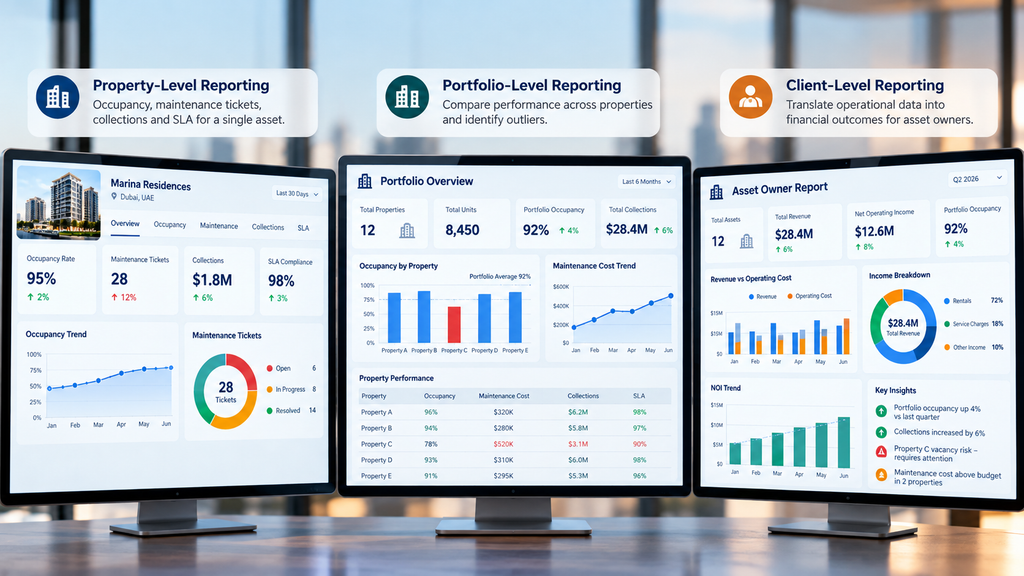
A Property Management Company operating at scale needs three levels of reporting that most organisations cannot produce without significant manual effort: property-level operations, portfolio-level performance, and client-level summaries for asset owners.
Property-level reporting covers occupancy, maintenance tickets, collections, and SLA performance for a single asset. Portfolio-level reporting compares performance across properties and identifies outliers. It shows which property is underperforming, which has the highest vacancy risk, and where maintenance cost is trending above budget. Client reporting translates operational data into financial outcomes for an asset owner who is not involved in the day-to-day operation.
Without a shared platform, each level of reporting is a manual build. Operations spend more time on reporting than on operations. The report that takes three days to produce is already outdated by the time it is read. Decisions are made on data that no longer reflects the current situation.
What good Property Management Company Infrastructure looks like at scale
Property Management Companies that manage growth without service degradation have a unified operational platform. It is a single system for maintenance requests, tenant communication, lease records, and collection tracking across all properties. Every team member, from the building supervisor to the operations director, is working from the same data.
The supervisor, the property manager, and the operations head can all see every ticket’s status at the same time. SLA tracking is automated. Overdue items surface in a daily dashboard rather than through individual chasing. The operations manager can see portfolio-wide SLA performance without asking anyone.
Client reporting is generated from the same data set, without a separate reconciliation exercise. The asset owner gets a monthly summary that is consistent and auditable, and the team does not have to go offline for three days to produce it. The report is a byproduct of operations, not a separate workstream.
The team structure question
Infrastructure does not replace the team. It changes what the team spends its time on. Consider a property manager who spends three hours a week on manual ticket follow-up and two hours generating a property report. That time is not going into the relationship work that justifies the role at scale.
When that time is reclaimed through automation and unified reporting, the team can focus on what drives client and tenant retention. That means proactive service, catching problems before they escalate, and data-grounded portfolio advisory conversations with asset owners.
The Property Management Companies that grow from 200 to 2,000 units without losing clients almost always built the operational platform before the growth required it. They made the investment while the portfolio was small enough for the existing approach to still work. That made the transition an upgrade rather than a rescue operation.
The right starting point
For most GCC and MENA Property Management Companies, the first step is a unified maintenance and tenant record. That means one system that every property team uses to log and track tickets and tenant communications, regardless of property. Not a separate system for each building. Not individual WhatsApp groups. One record.
That single change typically reduces ticket resolution time and gives the operations head their first complete portfolio view, even before any reporting or automation layer is added. The fragmentation that felt like a people problem usually turns out to be a data problem. Once the data is unified, the team no longer has to act as the link between systems that should be talking to each other, and can get on with their actual jobs.
How Metadata Technologies helps ?
Metadata Technologies gives GCC and MENA property management companies a unified operational platform. It is a single system for maintenance requests, tenant communication, lease records, and collection tracking across all properties in the portfolio.
SLA tracking is automated. Overdue tickets surface in a daily dashboard without manual chasing. Client reporting is generated from the same data set without a separate reconciliation exercise.
Is your Property Management Company growing? Talk to us to see how a unified platform changes the operational picture, and our team will walk through what it looks like at your current portfolio size.


FAQ
At what portfolio size does a unified Property Management Company platform become necessary?
Most Property Management Companies start experiencing coordination failures at 300 to 500 units across multiple properties. This is especially true when properties are in different locations or managed by different supervisors. The threshold is lower when the portfolio includes institutional clients with formal SLA and reporting obligations. The right time to implement a unified platform is before the coordination failures become client-facing, not after.
How do you migrate tenant and maintenance records from multiple systems into a single platform?
Migration typically starts with active records: current tenancies, open maintenance tickets, and pending collections. Historical records can be migrated in a subsequent phase or archived. The most important step before migration is standardising the data format across all properties. That step often reveals how inconsistently the same information has been recorded in different buildings. The standardisation exercise is as much a process review as it is a technical migration.
How does automated SLA tracking work in a property management context?
When a ticket is raised, automated SLA tracking assigns it a response and resolution deadline based on the issue category and property contract terms. The system flags tickets that are approaching or have exceeded their deadline. It surfaces them in a dashboard and generates follow-up prompts for the responsible team member. The operations manager can see SLA compliance rates by property, by contractor, and by issue type without requesting a report from the team.
What should a client performance report for a MENA asset owner include?
A well-structured client report covers occupancy rate and movement, collection performance against target, maintenance ticket volume and resolution rate, and SLA compliance. It also covers any notable lease or Facilities Management events during the period. It should be producible from the operational system without manual synthesis. It should also follow a consistent format across reporting periods so the asset owner can track trends over time. The report is most valuable when it goes beyond historical data and includes a brief commentary section in which the Property Management Company team flags risks and recommendations.
How do you maintain consistent service quality across properties managed by different supervisors?
Consistency at scale requires process standardisation rather than reliance on individual supervisors applying their own approach. The Property Management Company needs documented workflows for common situations: how a maintenance request is raised, how it is assigned, and what the escalation path is if it is not resolved within SLA. When those workflows are built into the operational platform, every supervisor follows the same process by default rather than by instruction.
How should a Property Management Company handle the transition from a small-team, high-touch model to a platform-driven model?
The transition works best when it is framed as adding infrastructure to support the existing team rather than replacing how the team operates. The first priority is eliminating the manual coordination work that is currently absorbing team capacity: manual ticket chasing, manual reporting, and manual cross-property communication. Once that capacity is freed, the team can direct it toward the high-value activities that the platform cannot do: tenant relationships, proactive problem identification, and client advisory.
What is the typical ROI calculation for a unified Property Management Company platform at the 500 to 2,000 unit scale?
The most concrete ROI inputs are:
- Analyst and coordinator hours freed through automation
- SLA penalty exposure reduced through better compliance tracking
- Client retention rate improvement from more consistent reporting and faster issue resolution
Consider a Property Management Company managing 1,000 units. A 10 percent reduction in coordinator time and a 5 percent improvement in client retention typically produce an ROI that exceeds the platform cost within the first year of operation

 Apr 19, 2022