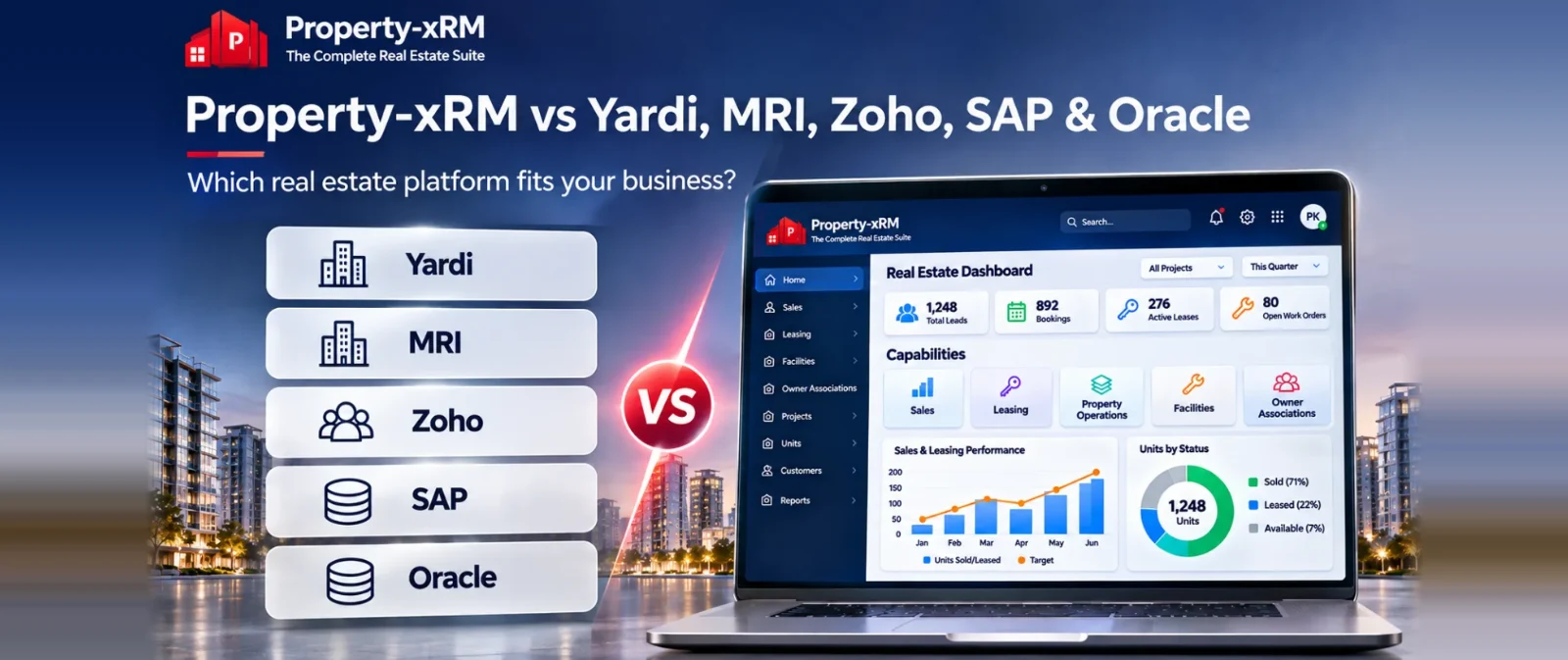
Property-xRM is a real estate CRM built on Microsoft Dynamics 365 for developers, property managers and portfolio owners. This guide compares it with Yardi, MRI, Zoho, SAP and Oracle side by side, so you can see which platform fits the way your business works. Part 1 compares the options; Part 2 shows what Property-xRM covers.
Key takeaways
- Yardi and MRI: property management and accounting suites, strongest for portfolios run around leases, rent and the general ledger.
- Zoho CRM: a flexible, affordable general CRM that suits small agencies and brokerages with simple sales pipelines.
- SAP and Oracle: enterprise ERPs that remain the core for finance, HR and capital projects, with customer work usually handled in a separate CRM.
- Standard Dynamics 365 or Salesforce: powerful CRM platforms that need significant custom build to handle units, payment plans, leases and handovers.
- Property-xRM: a real estate CRM built on Microsoft Dynamics 365 that covers sales, leasing, facilities and customer service. Start with the area you need, add others as your portfolio grows, and keep finance in your ERP. Property-xRM is listed on Microsoft AppSource.
- In this guide: Part 1 compares all the options side by side, with six questions to ask any vendor and a self-check. Part 2 covers where Property-xRM fits: capabilities, 5-year cost, ERP integration, implementation and customer results.
Part 1
Compare your options
Start with the type of work your business does most. The grid shows what each option is built for; the boxes below go platform by platform.
All platforms compared at a glance
| Option | Built for | Real estate data model | Finance runs in | Best fit |
|---|---|---|---|---|
| Yardi or MRI | Property management and accounting suites | Strong for properties and leases, inside the vendor suite | Their own property accounting | Accounting-led portfolios that want one vendor |
| Zoho CRM | General-purpose CRM | Built with custom modules during the project | Zoho apps or an integrated finance system | Small agencies and brokerages that want a quick start |
| SAP or Oracle | ERP-first suites with a separate CRM layer | Real estate modules focused on finance and assets | SAP or Oracle | Enterprise finance, HR and capital project controls |
| Standard Dynamics 365 or Salesforce setup | CRM platforms built for every industry | Built during the project as a custom real estate layer | Your connected ERP | Firms with in-house capacity to build and maintain a real estate layer |
| Real estate CRM on Dynamics 365, such as Property-xRM | Developers, property managers and portfolio owners | Projects, units, payment plans, leases and assets from day one | Your connected ERP | Sales, leasing or facilities alone, a mixed portfolio, or firms planning to scale into more |
Platform-by-platform comparison
Open any comparison for the detail.
Property-xRM vs Yardi and MRI
Property-xRM is built for developers, property managers and portfolio owners who want one customer platform on Microsoft Dynamics 365 and finance in a corporate ERP. Yardi and MRI offer complete property suites, with their own CRM tools and their own property accounting. Property-xRM takes over customer-facing work and operations at the pace that suits you:
- One customer record across the lifecycle: buyer, owner, tenant and community member, from first enquiry through sale, handover, leasing and service.
- Developer sales built in: project, building, floor and unit inventory, offers, reservations, SPA generation and payment plans tied to construction milestones.
- Leasing, facilities and owner associations on the same platform: renewals, retail leasing, work orders, preventive maintenance and community management.
- Native Microsoft 365: Outlook, Teams, SharePoint, Power BI and Microsoft Copilot work directly on CRM records.
- Finance in your ERP: SAP, Oracle, Dynamics 365 Finance & Operations, Business Central or any other ERP you run, so your corporate finance stays the single source of truth.
Property-xRM vs Zoho CRM
Property-xRM is built for enterprise developers, property managers and portfolio owners; Zoho CRM is a flexible general-purpose CRM that serves agents, brokers and small agencies well. Real estate firms choose Property-xRM for:
- Inventory of thousands of units across projects, towers, phases and floors, with unit locking for high-volume launches
- Multi-project, multi-company and multi-entity portfolios in one system
- Payment plans, bookings, SPAs, cancellations, transfers and resales as standard, not custom builds
- Retail leasing, handover and snagging, move-in and move-out, and owner association management out of the box
- Cloud or on-premise deployment
For a small agency with simple, listing-led sales that wants a quick start, Zoho can be the simpler option.
Property-xRM vs SAP and Oracle
SAP and Oracle are ERP-first suites with a separate CRM layer. Property-xRM is a packaged real estate CRM that connects to them, so firms on SAP or Oracle often run both: the ERP for finance, Property-xRM for customers and operations. Real estate firms choose Property-xRM because:
- Sales teams work with units, availability, payment plans and bookings from day one
- AI is grounded in real estate data: units, payment plans, bookings and leases
- Property-xRM comes with 100+ real estate implementations and 70+ in-house real estate CRM professionals
- Configuration replaces long custom build projects, with phased go-live by module: sales, then leasing, then facilities
SAP and Oracle remain the natural choice for enterprise finance, HR and construction and capital project controls.
Property-xRM vs a standard Dynamics 365 or Salesforce setup
Microsoft Dynamics 365 and Salesforce are world-class platforms, built to serve every industry. That breadth is their strength, and it is why the real estate layer is best added as a proven product rather than built from scratch on each project.
A CRM out of the box works with accounts, leads, products and orders. A real estate business works with projects, towers, floors and units; payment plans tied to construction milestones; bookings, SPAs, transfers and handovers; leases, renewals and service requests. Building all of that from scratch turns into a long, costly project, and each firm ends up solving the same problems again. A packaged real estate solution brings:
- A real estate data model from day one: projects, buildings, floors and units with live status, linked to buyers, owners and tenants
- Proven processes: unit locking on launch day, payment plans, SPA generation, transfers, renewals, handover and snagging, refined across 100+ implementations
- Regional requirements built in: government portals for land registration, escrow and tenancy registration, plus multi-currency and multi-entity set-ups
- Faster, lower-risk go-live: the project configures rather than builds, so teams go live module by module
- Smoother upgrades: the real estate layer is maintained as a product in step with platform releases, instead of custom code retested at every update
- Room to make it your own: the platform’s low-code tools stay available for anything unique to your business
Property-xRM brings that layer to Dynamics 365 from day one, and PropertyFlex does the same natively on Salesforce, so your teams get everything their platform offers, already shaped for real estate.
Six questions to ask any vendor
Whichever platform is on your shortlist, these questions show whether it is built for how a real estate business works.
| Question to ask | Property-xRM’s answer |
|---|---|
| Is it built for real estate firms with thousands of units, or for agents and brokers? | Built for developers, property managers and portfolio owners, with 150M+ sq ft managed across 100+ implementations |
| Can sales, leasing, property operations and facilities run on one customer record? | Yes. One record follows the customer from buyer to owner, tenant and community member |
| Are unit inventory, payment plans and post-sale processes part of the product, or built during the project? | Part of the product, so the project configures rather than builds |
| Does it run on a platform your teams already use? | Yes. Property-xRM runs on Microsoft Dynamics 365, with Outlook, Teams, Power BI and Copilot built in |
| Does finance stay in your corporate ERP? | Yes. Property-xRM connects to SAP, Oracle, Dynamics 365 Finance & Operations, Business Central or any other ERP you run |
| Can your own team change fields, forms and workflows after go-live? | Yes, with low-code configuration and no lock-in to one implementer |
Evaluating a platform we haven’t covered here? Tell us which one, and our specialists will walk you through a side-by-side comparison.
If three or more statements below are true for your team, it is worth comparing platforms now.
Is it time to switch? A 60-second self-check
Tick every statement that is true for your team today. Your result updates as you go.
Get a full comparison, personalised for you
Part 2
Where Property-xRM fits
Property-xRM is a real estate CRM built on Microsoft Dynamics 365, listed on Microsoft AppSource. Property-xRM serves developers, property managers, mall and retail operators, facilities teams, owner associations and mixed-use portfolio owners.
Why Microsoft matters for real estate
Because Property-xRM runs on Microsoft Dynamics 365 and the Power Platform, real estate firms get the strength of the Microsoft cloud with a real estate layer on top:
- One data foundation: Microsoft Dataverse keeps leads, units, leases, payment plans and cases in one model, so data is ready for Copilot and AI from day one
- Live portfolio views: Power BI dashboards replace the month-end reports someone builds by hand
- Changes without a quote: Power Apps and Power Automate let your own team adjust forms, approval rules and workflows after go-live
- Work where your teams already are: sales, leasing and service teams work from Outlook and Teams, with documents in SharePoint
- Enterprise-grade security: Microsoft Azure security, compliance and regional data centres support data-residency needs across the GCC and APAC
- Always current: Metadata maintains Property-xRM in step with Microsoft's release cycle, so new Dynamics 365 and Copilot features reach your teams without rework
What Property-xRM covers
| Area | Capabilities |
|---|---|
| Sales | Project, building, floor and unit inventory with live status; unit locking on launch day; offers; reservations; payment plans; SPA generation and digital signatures |
| Post-sale | Cancellations, primary and secondary transfers, resale and buy-back, joint owner changes, unit upgrades and downgrades |
| Brokers and marketing | Broker registration, commissions, unit allocation and broker portal; email, SMS and omnichannel campaigns; campaign-to-booking attribution |
| Leasing | Residential, commercial and retail leasing from enquiry to renewal; brand mix and revenue share for malls; rent escalations; occupancy across the portfolio |
| Handover | Inspection templates, snagging app with photos, move-in and move-out on mobile |
| Property operations and facilities | Asset hierarchy linked to project, property and unit; planned and reactive maintenance; outsourced vendors; SLA rules with escalation; IoT-triggered work orders |
| Owner associations | Levy management, committee engagement, 360-degree owner record, defect tracking |
| Customer service and portals | 360-degree customer and unit view, unit-linked cases, call centre integration, customer and tenant self-service portal for statements and requests |
| Microsoft 365 and AI | Outlook, Teams, SharePoint and Power BI on CRM records; Microsoft Copilot grounded in real estate data; AI lead scoring and unit matching |
| Integrations and localisation | SAP, Oracle, Dynamics 365 Finance & Operations, Business Central and other ERPs; government portals for land registration, escrow and tenancy registration; payment gateways; multi-language, multi-currency and multi-company |
5-year cost of ownership
Licence price is one line in the budget. Over five years, the larger costs are building the real estate layer, connecting extra apps and reworking custom code at every update.
| Cost driver | Property-xRM on Dynamics 365 | A general CRM or ERP CRM layer customised for real estate |
|---|---|---|
| Real estate functionality | Included | Custom build or add-on per project |
| Implementation | Configure a proven product | Design and build |
| Go-live | Phased by module | Full design first |
| Mixed portfolio | One platform | Additional apps, modules and connectors |
| Upgrades | Maintained by Metadata with Microsoft releases | Custom code retested at every update |
| Scaling to more projects | Configure new projects | Extend custom modules |
| Skills | 70+ Metadata real estate specialists, backed by the wider Dynamics 365 talent pool | Fewer real estate specialists |
| Data migration | Proven approach for units, bookings and payment history | Mapping designed from scratch for each project |
| Reporting and AI | Power BI and Copilot on the same customer and unit data | Separate reporting tools, exports or extra connectors |
| Security and hosting | Microsoft cloud security, compliance and regional data centres | Varies by vendor, add-on and hosting choice |
| Support | One accountable team for the real estate product and platform | Split between the platform vendor and the build partner |
ERP fit
Switching to Property-xRM does not mean replacing your ERP. Property-xRM handles sales, leasing, facilities and customer service; finance stays in SAP, Oracle, Dynamics 365 Finance and Operations, Business Central or any other ERP you run. Read more in Dynamics 365 CE vs Dynamics 365 F&O for real estate.
- Microsoft-native integration: Power Automate flows and Azure Integration Services, with native connectors for Dynamics 365 Finance & Operations and Business Central
- Two-way flow of bookings, invoices, receipts and customer balances
- Integration ownership and cost agreed before signing
- On SAP ECC? Mainstream maintenance ends on 31 December 2027. Go live on your current ERP now and connect to S/4HANA when you move.
How implementation works
A phased approach delivers value early, with two sign-off gates so nothing is built or launched until you approve it. See our guides to data migration and go-live configuration.
- Kick-off: named project leads on both sides, your project sponsor, weekly status reviews and an agreed escalation path
- Requirements: workshops with your teams produce a Business Requirements Document, then a Functional Requirements Document that also flags risks early. Your sign-off is the first gate before configuration starts
- Configure and test: Property-xRM is configured for your projects, rules and approvals, then quality-tested by our team
- Migrate data: customers, units, bookings and payments
- Pilot and acceptance: a conference room pilot with your key users, then user acceptance testing. UAT sign-off is the second gate before go-live
- Train the trainer: we train your internal champions, who then train end users
- Phased go-live: sales first, then leasing, then handover and facilities
- Support and handholding: onsite and remote support from a dedicated post-go-live team
How we keep the project on track
- Change control: any change is requested in writing, and its time and cost impact is agreed with you before work starts
- Risk log: every risk gets a named owner, a mitigation plan and a review in status reports and steering committee meetings
- Document reviews: key documents are reviewed by your stakeholders and corrected before each phase closes
Customer results
 GCC mixed-use developer
One developer, six business lines, one system
Sales, leasing, facilities, owner associations and customer service moved from separate tools onto Property-xRM, with Oracle EBS for finance.
- 22,000+units managed
- 3,700+leases, lead to renewal
- Up to 40%faster lease renewals
- 30%less service time
 Global mixed-use developer
From 2,000 to 50,000 units on one CRM
Manual lead handling, hand-run collections and manual AML checks replaced by Property-xRM, synced with Oracle Fusion.
- 50,000+units managed
- US$15B+in sales
- 12+countries
- 1M+leads in one system
Related reading
Blog
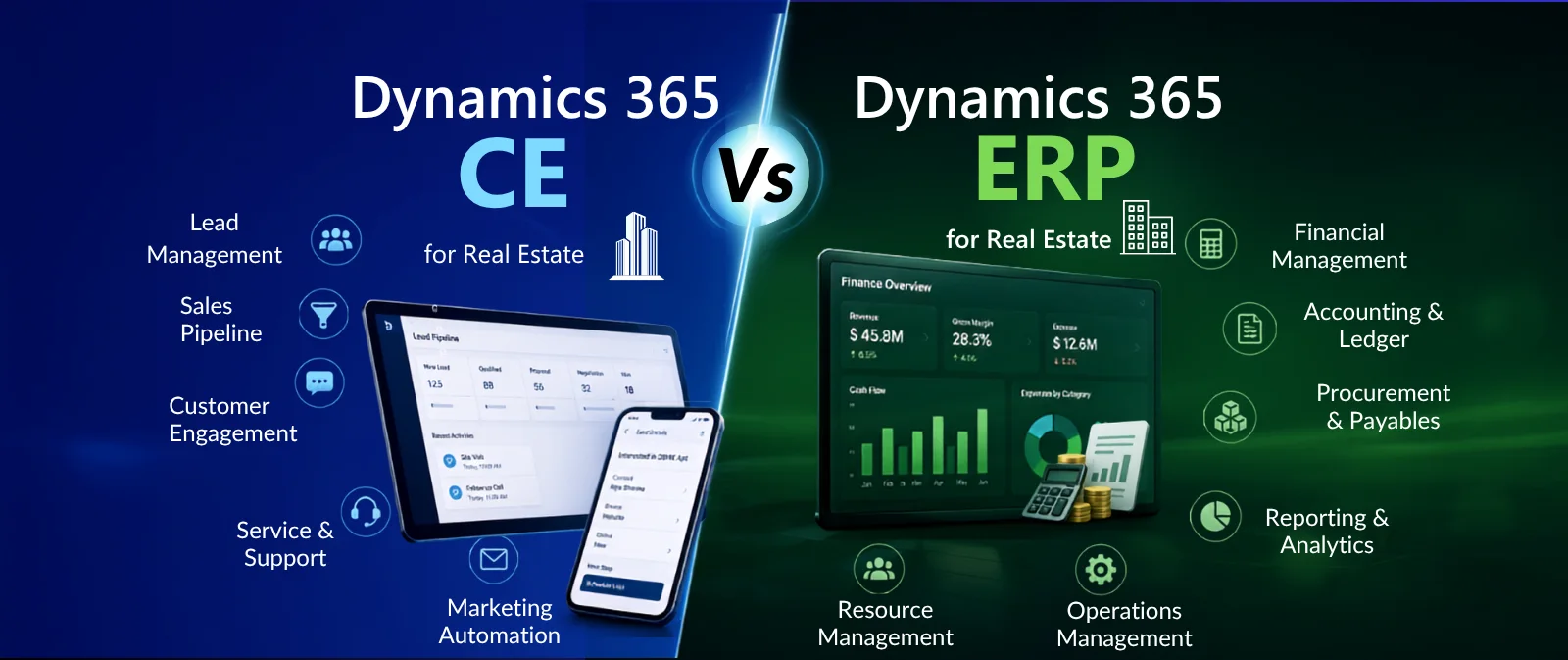
Dynamics CE vs Dynamics ERP: which should your real estate solution be built on?
Why sales, leasing and facilities belong in the CRM, and finance in the ERP.
Read the article →
Blog
7 reasons real estate CRM implementations fail
How an experienced partner prevents the most common project failures.
Read the article →
Blog
Real estate CRM adoption failure: why it happens and how to fix it
Why teams stop using a new CRM, what it costs, and the fixes that work.
Read the article →Frequently asked questions
What is the best alternative to Yardi or MRI for real estate developers?
For developers and portfolio owners who want one customer platform on Microsoft Dynamics 365, Property-xRM is a leading alternative. Property-xRM can run sales, leasing, facilities and owner associations end to end, or start alongside your current system and grow module by module, and connects to SAP, Oracle, Dynamics 365 Finance & Operations, Business Central or any other ERP you run for finance.
Does Property-xRM replace Yardi or MRI, or work alongside them?
Either. Many firms start with sales, leasing and customer care alongside their current system, then move more over when it makes sense. Finance stays in your corporate ERP throughout.
Which ERP systems does Property-xRM integrate with?
SAP, Oracle (including Oracle EBS, Oracle Fusion and JD Edwards), Microsoft Dynamics 365 Finance & Operations, Dynamics 365 Business Central and other ERPs.
Is Property-xRM better than Zoho CRM for real estate?
For enterprise developers, property managers and portfolio owners, Property-xRM is the more complete fit. Property-xRM manages thousands of units across projects and entities, with payment plans, bookings, leasing and facilities out of the box. Zoho remains a good option for small agencies with simple, listing-led sales.
Why choose Property-xRM over SAP or Oracle CRM?
Property-xRM is a packaged real estate CRM, so sales teams work with units, availability and payment plans from day one. Property-xRM connects to SAP or Oracle, which stay in place for finance.
Does Property-xRM support AI?
Yes. Microsoft Copilot works inside Outlook, Teams and the CRM, grounded in real estate data such as units, payment plans, bookings and leases, with AI lead scoring and unit matching.
Is Property-xRM only for real estate developers?
No. Property-xRM serves developers, property managers, mall and retail operators, facilities teams, owner associations and mixed-use portfolio owners, covering sales, leasing, property operations and community management on one platform.
Which systems does Property-xRM work with or replace?
Property-xRM can work alongside or take over from property management systems such as Yardi and MRI, general-purpose CRMs such as Zoho, rental property management tools, and the spreadsheets and point tools that grow up around them. Finance stays in SAP, Oracle, Dynamics 365 Finance & Operations, Business Central or any other ERP you run.
Whatever you run today, we can map the way forward
Whether you run Yardi, MRI, Zoho, a rental property tool, a standard Dynamics 365 or Salesforce setup, or spreadsheets, our team has seen it. With 100+ implementations across 12+ countries, we can show you what Property-xRM looks like for your portfolio, alongside what you run today, and how Property-xRM connects to your ERP.
Comparison based on publicly available product information as of November 2026. Every platform here continues to add AI features; this guide focuses on how each fits the way a real estate business works. All trademarks belong to their respective owners.

 Apr 19, 2022